
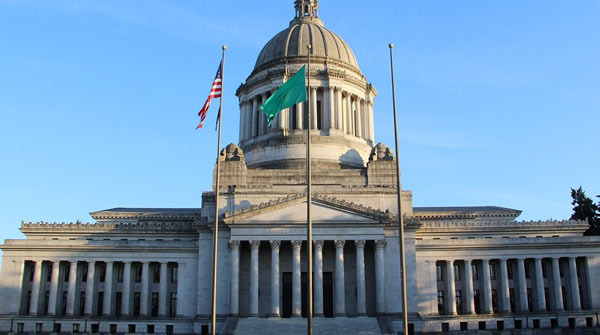
However, up close, this building symbolizes the history and identity of Washington State itself. The capitol was established in 1928 and was one of the largest and most magnificent buildings in the western United States at that time. Its Greek temple-style design features a large circular dome, which is said to be the fourth largest in the entire country.
The exterior walls are made of gray granite sourced from the Pacific coast of Washington, while the interior is adorned with marble and bronze sculptures. Upon entering, one is greeted by a massive dome ceiling that rises about 87 meters, with a chandelier weighing over 5 tons hanging inside.
This chandelier was made by the Louis Company and is considered an iconic artwork of American public buildings from the 1920s. The Washington State Capitol complex is not just a single building; it also includes the Governor's Mansion, the Supreme Court building, and several annexes, forming a complex administrative area.
All three branches of government—executive, legislative, and judicial—operate in this area. Therefore, the vicinity of the capitol is always bustling with political activities and civic events. Especially during the legislative session held at the beginning of each year, not only legislators but also civic groups, students, and local residents gather for various discussions and rallies.
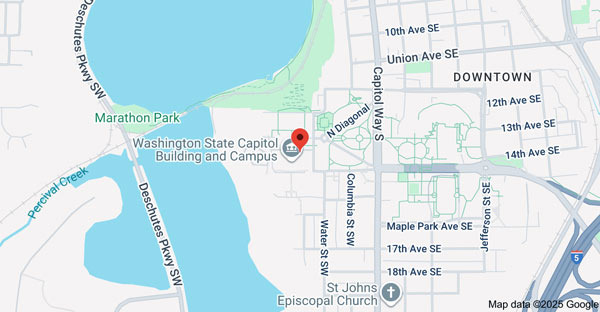
Another charm of the Washington State Capitol is that it serves as a 'political space in nature.' Behind the building, lush forests and the Pacific coastline extend, and in spring, cherry blossoms bloom beautifully.
Many residents come here for walks on weekends, and it is also a popular spot for wedding photos. Whenever a friend visits from Bellevue, I always take them here at least once. It is a space where politics, art, and nature coexist.
The capitol is not just a place where politicians work; it also serves as an 'open square' where the citizens of Washington State gather to voice their opinions. In fact, there are many programs where students tour the legislature or participate in mock legislative experiences.
This is also why the Washington State government places particular emphasis on democracy education. An interesting fact is that this building has withstood several earthquakes without collapsing. There were two major earthquakes in 1949 and 2001, but through restoration work, its original form has been largely preserved.
Structurally impressive, this building symbolizes the history of the state. Standing at the top of the capitol, one can overlook Puget Sound, with the snow-capped Mount Rainier visible in the distance. Politics often feels rigid and complex, but standing here, one can sense a certain human warmth.
When rain falls on the white dome and sunlight filters through the raindrops, it feels as if all the stories of Washington State are contained within this building. Over nearly a century, countless laws and decisions have been made here, but ultimately, this place symbolizes the harmony between people's lives and nature. Therefore, every time I see this capitol, I feel it is more like 'the heart of Washington' than just 'the center of politics.'





 Bald Eagle Brothers |
 Bacon King Blog |
 PETRO Vatican Shrine |
 Seattle - Emerald City |
 Real Estate Agent USA |
  citrus pop |
  Onion Ring |
  phoenixia |
  viewtop |
  loverun |
  Kim Do Sun |
  SEVEN SEVEN |
  yentra |
  Make My Day |
  Victory 1988 |
  Tonky |
  viroma |
  cookie |
  Live and that's it |
  Alright Twain |
  eatontown blog |
  HAWAII Korean Church News |
  Amore |
  linex |
  Balancework |