
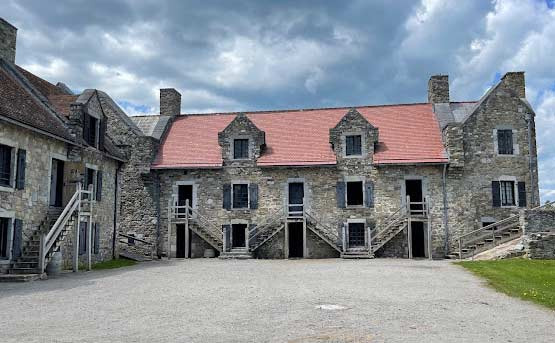
"Are there castles in America?" When I first heard this question, I couldn't help but smile.
When I think of castles, I picture the stone walls and towers of medieval Europe, along with dramatic battles.
However, there are indeed traces of 'castles' and 'forts' in America.
Especially in the Eastern United States, there are military forts and defensive structures built by European powers during their struggles for this land that still stand today.
The Most Impressive Historical Forts in the East
-
Fort Ticonderoga (New York)
This fort was a crucial strategic point during the French and Indian War and the American Revolutionary War.
Originally built as Fort Carillon by the French in 1755,
it was later captured by British and American revolutionary forces and renamed.
It has now been converted into a museum showcasing life, weapons, and uniforms from that era,
making it a great place to learn history while traveling with kids. -
Fort McHenry (Maryland)
Built in the late 18th century to protect Baltimore Harbor,
this fort is famous for its defense against the British attack in 1812.
The battle inspired Francis Scott Key to write a poem that became
the United States national anthem, "The Star-Spangled Banner."
Due to its historical significance and location, it attracts many tourists every year. -
Fort Christian (U.S. Virgin Islands)
Built by the Danes in 1666, this fort is one of the oldest European-style structures in America.
Its medieval European appearance gives it the feel of a quaint Danish village.
It currently operates as a museum and exhibition center,
showcasing another historical point in the U.S. territories. -
Fort Knox (Maine)
This is different from Fort Knox in Kentucky, which stores gold.
Fort Knox in Maine was built in the mid-19th century in preparation for potential conflicts with Britain,
featuring steel cannons and a thick stone fort.
In the summer, it offers not only fort tours but also 'ghost tours' that are fun for kids.
The Eastern United States is where European immigrants first set foot.
From the 17th century, colonial powers such as England, France, the Netherlands, Spain, and Portugal continuously fought over military strongholds in this region. Naturally, they built forts and defensive walls near the coast or rivers.
Moreover, due to frequent conflicts with Native Americans and colonial disputes among European powers, forts capable of housing troops and storing weapons were essential facilities. The 'traces of Europe' before the founding of America are preserved in these castles and forts.
In the Midwest, such as Ohio, Illinois, Missouri, and Kansas, there are hardly any 'castles' to speak of.
While the Eastern United States was occupied by European powers since the 1600s, the Midwest was mostly settled in the 1800s. By this time, military technology had advanced, making the tradition of building large castles less significant. Defense was less important than mobile armies, weapons, and railroads.
Additionally, the Midwest is not coastal and has distant borders with neighboring states, reducing the need for defensive castles. Furthermore, conflicts were more centered around Native American disputes, for which temporary barracks and mobile bases were more practical than forts.
The East has many rivers, seas, and hills, making it favorable for defense, while the Midwest is mostly flat land. Even if forts were built, their defensive efficiency would be low, so railroads, tent fortifications, and infantry-centered mobile warfare were more effective.
If you are planning a trip to America, I recommend designing your travel itinerary around historically significant castles and forts rather than just tourist attractions.
Especially in the East, you can see the closest traces of European history before the founding of America, where the history of immigration, war, cooperation, and betrayal is alive and breathing.
Visiting these castles reveals the tension of the times, the will to survive, and the traces of those who dreamed of a new world.
How about a trip to the East centered around castles this summer?






 candytip |
 Gold Bar |
 Pirate Ship Popcorn Maker |
 Montgomery Mom |
 Anjollinya Blog |
 squidogame |
 Margarine Daebimama |
 eatontown blog |
 cloudyday |
 Google Idea |
  Korean Mom |
  My NYC |
  moo moo |
  Mr Oh |
  forevergee |
  festival |
  manchester |
  constant |
  Leapfrog Move |
  vibranto |
  Tora Tora |
  yellowbutter |
  Dolly |
  US Embassy |
  NYC saladbar |
  Finding Superfoods |
  lightyear |
  song bang |
  vexomo |
  Indiana Jones |