
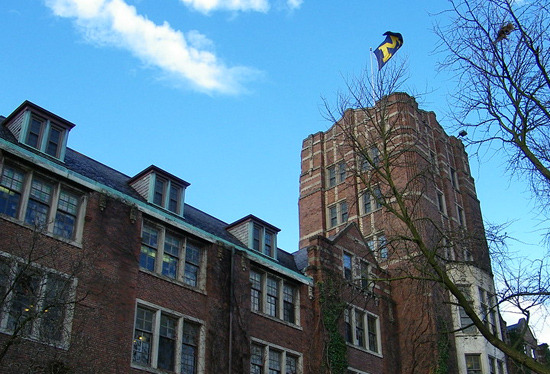
When people talk about Ann Arbor, many think of it as just a "college town with the University of Michigan."
While this isn't entirely wrong, I believe this city has a much more complex economic structure when you look at it closely.
It's true that the University of Michigan is the largest employer with over 30,000 staff, but the scale of the city's economy cannot be explained by just one university.
Just looking at the annual economic impact of over $15 billion shows that it has surpassed the level of a simple campus town.
A notable aspect of this city is its tech startup ecosystem. True to its college town nature, over 500 startups have been nurtured around the economic development organization Ann Arbor SPARK, earning it the nickname 'Silicon Valley of the Midwest.'
In fact, Google has an office here with more than 1,000 employees, creating a structure that allows for the direct hiring of talent from the university. Additionally, the cybersecurity company Duo Security, which originated from the University of Michigan, was acquired by Cisco Systems in 2018 for about $2.3 billion, showcasing the potential of the local startup ecosystem.
Another surprising fact for many is that the global pizza chain Domino's Pizza has its headquarters right in this city.
Located at 30 Frank Lloyd Wright Dr, the headquarters serves as a landmark symbolizing the area, going beyond just being an office. Although Domino's is reportedly facing challenges due to the current economic climate, the presence of international companies is diversifying the city's industrial structure.
The automotive industry cannot be overlooked either. Major automakers like Ford Motor Company, General Motors, and Stellantis all operate research and engineering facilities in the Ann Arbor area, with a focus on vehicle testing and autonomous driving infrastructure. The addition of the University Research Corridor, a research collaboration, creates a natural connection between academia and industry.
The abundance of talent in the region makes this possible. This demographic composition is also a crucial factor in understanding the city. Over 70% of adults hold a bachelor's degree or higher, classifying it as one of the most educated cities in the U.S. This isn't just a statistic; it connects directly to the economic structure. A continuous supply of skilled talent attracts businesses, which in turn fosters the growth of startups, creating a virtuous cycle.
However, an interesting point is that despite these conditions, the median household income isn't as high as one might expect. If anyone knows why, please leave a comment! Haha.
It's roughly in the mid-$60,000 to low-$70,000 range, which I believe is due to the high proportion of students in the population.
In simple terms, the city's overall 'intellectual level' and 'income level' do not necessarily correlate. Understanding this aspect reveals that Ann Arbor is not just a livable college town, but a multifaceted city where education, technology, and industry coexist.
 RadishCyberOp



 Smile Face |
 Helpful Life Stories |
 Casa Mia |
 Study Abroad Life Know-How Tips |
 pravix22 |
 crumb |
 InDiGo |



 marydock |
  newyorker 101 |
  coffeee |
  |
|  Christopher |
  sylven |
  Sammy Beach |
  Bliss O |
  blue ocean |
  greenlight |
  Watanaka Karametibaksa |
  castle |
  xelton52 |
  carefree |
  vrixen73 |
  AZ Road Master |
  Victory 1988 |
  summita |
  business lim |
  Colorado Lee |
  Make My Day |