

 '
'
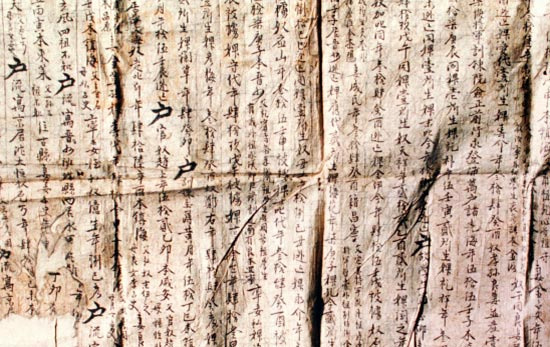
When you think of household registers, it's easy to picture a document filled with names and family information, like a dense certificate.
However, the household registers of the Joseon Dynasty were not just simple documents; they were mechanisms for classifying people and subtly drawing lines that should not be crossed.
The reason you could tell who someone was just by looking at their household register lies here.
Those who held official positions were recorded as scholars, commoners as infantry or cavalry, and slaves were distinctly noted as either male or female slaves.
Additionally, recording the wealth of grandparents, great-grandparents, and maternal grandfathers indicates that the continuity of the family line was highly valued.
In a single piece of paper, a person's past and future were summarized like database information.
However, this seemingly solid order began to subtly shake over time.
Following the household registers reveals these changes in numbers. Up until the early 18th century, the yangban class was clearly a minority, but over time, the number of yangban households increased while commoners and slaves decreased. The disappearance of slaves, in particular, was rapid.
This change stemmed not from natural population fluctuations but from the movement of money and power.
As economically powerful commoners and lowborn individuals began to cross the threshold of the yangban class, the yangban society appeared to expand outwardly but was hollowing out from within. The increase in the privileged class meant that privilege was no longer truly privileged.
After the late 17th century, as the population surged, Seoul was no longer a city confined within its walls.
Goods gathered and people flocked to areas like Mapo, Yongsan, and Seogang along the Han River. A city was created where one could survive a day just by unloading and reloading goods from boats. Shanties increased around Cheonggyecheon, and many people began to spend the night under bridges.
Seoul had already become a city driven by commerce and labor. When comparing the population size of Seoul at that time to other cities in different countries, the capital of Joseon was by no means lagging behind. It was comparable in size to European cities before the Industrial Revolution.
As the city grew, so did its problems. With a shortage of housing, yangban began to use their status to seize commoners' homes, and it took time for this to be classified as a crime. The flooding of Cheonggyecheon, winter deaths, and begging were also shadows of the city.
King Yeongjo's river improvement project was not just a simple civil engineering project; it was a representative case of the state intervening in problems created by population growth. Through the process of correcting waterways and demolishing houses, Seoul gradually began to take on the face of a modern city.
Amidst this massive wave of change, the group most slowly yet deeply affected was women. The saying that men are the sky and women are the earth was not just a metaphor but a structure of life.
Education was different, spaces were separated, and marriage was a duty rather than a matter of love. Nevertheless, women were the center of the household and held property rights and rights as mothers. In the early Joseon period, a daughter's inheritance rights were taken for granted, and a wife's property could not be arbitrarily touched by her husband.
However, as the Joseon period progressed, this balance began to collapse. With the strengthening of ancestral rites and the importance of the eldest son, women's share diminished. Chastity became a virtue that was enforced rather than a choice, and the ideal of a virtuous woman became a standard rather than an option.
Divorce was no different. The term "seven reasons for divorce" sounds frightening, but in reality, the state did everything possible to suppress divorce. Ironically, this ensured many women a place in society, but they had to live in silence under the name of modesty.
The story that began with household registers ultimately returns to people's lives. The society that tried to bind individuals with numbers and regulations gradually unraveled in the face of human movement, desire, and economic power.
The traces of this change remain in a line of a household register, the waters of Cheonggyecheon, and the marriages and divorces of a woman. Thus, these ancient records still strangely resemble the present.







 Korean Mom |
 novapixel |
 Peter Pan Pet |
 horse |
 Sunset Oregon |
 xylora |
 Aura-Infused WACAM |
 wendra |
 There Are Such Things in the World |
 Atlanta Mama |
  Baguette Blog |
  US Embassy |
  My NYC |
  moo moo |
  Mr Oh |
  forevergee |
  festival |
  manchester |
  constant |
  Leapfrog Move |
  vibranto |
  Tora Tora |
  yellowbutter |
  Dolly |
  NYC saladbar |
  Finding Superfoods |
  lightyear |
  song bang |