
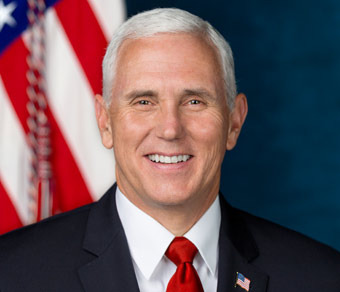
Mike Pence served as the vice president of the United States under President Donald Trump from 2017 to 2021.
He was the governor of Indiana (2013–2017) and previously served as a congressman for 12 years.
Pence is known for being a Republican politician who emphasizes conservative Christian values and economic policies. As vice president, he notably led the COVID-19 response task force and played a role in promoting key policies of the Trump administration.
Mike Pence was born and raised in Columbus, Indiana, on June 7, 1959. He is one of six siblings and the son of mother Anne Jane 'Nancy' and father Edward Joseph Pence Jr. His father served in the Korean War and received a Bronze Star, which Pence proudly displayed in his office.
Pence has German and Irish ancestry and was named after his maternal grandfather, Richard Michael Cawley. His grandfather immigrated from County Clare, Ireland, through Ellis Island and worked as a bus driver in Chicago. His grandmother was also of Irish descent.
After graduating from Columbus North High School in 1977, Pence earned a Bachelor of Arts in History from Hanover College and obtained his Juris Doctor (JD) from the Indiana University Robert H. McKinney School of Law in 1986. During college, he was active in the Phi Gamma Delta fraternity and served as its chapter president.
In 1988, at the age of 29, Mike Pence first ventured into politics after graduating from law school. He ran as the Republican candidate against incumbent Democratic Congressman Phil Sharp in Indiana's 2nd district. He narrowly won the Republican primary, but unfortunately, he could not celebrate his victory as his father passed away from a heart attack shortly after the primary.
As a political newcomer, Pence gained attention by biking around his district to campaign, but he lost to Sharp in the general election. He then spent the next two years preparing for a rematch against Sharp, where they had a very close race. However, his support plummeted due to a campaign finance scandal that revealed he had used campaign funds for personal home loans and living expenses.
As his chances dwindled, Pence resorted to negative campaigning. For example, he spread false claims that Sharp was trying to attract a nuclear waste storage facility or ran ads suggesting Sharp was a "slave" to Middle Eastern oil money by hiring Arab actors. After this controversy, he suffered a significant defeat and later wrote an article for a local newspaper titled "A Confession of a Negative Politician," reflecting on his mistakes. He vowed, "If I run for office again, I will not engage in negative campaigning."
After stepping away from politics, Pence worked as a Christian conservative lawyer and hosted the radio show "The Mike Pence Show." The show gained significant popularity, showcasing his eloquence. Notably, Pence had previously placed third in a public speaking competition during his school years.
The success of the radio show led to increased support for the Republican Party in the area. Eventually, in 1995, Phil Sharp retired from politics, and David McIntosh succeeded him, allowing the Republicans to take the 2nd district. In 2000, when McIntosh left his congressional seat to run for governor, Pence re-entered politics and eventually rose to become governor and vice president, rooted in traditional values and conservative beliefs.
In his youth, he was a Roman Catholic and a Democrat, even voting for Jimmy Carter in the 1980 presidential election. However, during college, he embraced evangelical Christian faith, which shifted his political leanings to the right. He was particularly influenced by Ronald Reagan's "common-sense conservatism."
While serving as governor of Indiana, the state's economy heavily relied on manufacturing, resulting in a GDP growth rate that fell far below the national average of 2%. Consequently, significant budget cuts were necessary, leading to further deterioration of essential services such as public schools, correctional facilities, and infrastructure.
However, he also achieved notable successes. He implemented the largest tax cuts in history while maintaining the $2 billion budget surplus left by his predecessor. Additionally, it was quite progressive and positively viewed that, as a Republican, he actively embraced the public healthcare expansion under Obamacare.
Michael Richard Pence, born on June 7, 1959, is an American politician who served as the 48th vice president of the United States under President Donald Trump from 2017 to 2021.
Earlier in his career, Pence served in the U.S. House of Representatives from 2001 to 2013, representing Indiana. He also held the position of chair of the House Republican Conference from 2009 to 2011. Known for his conservative views, Pence has been a vocal supporter of the Tea Party movement and a dedicated member of the Republican Party.
He earned a B.A. in History from Hanover College in 1981 and a J.D. from the Indiana University Robert H. McKinney School of Law in 1986. After graduating from law school in 1986, Pence worked as an attorney in private practice. He continued to practice law following his second unsuccessful run for Congress.
During Mike Pence's tenure as governor of Indiana, the state's GDP, heavily reliant on manufacturing, grew at a rate far below the national average of 2%. This sluggish growth forced significant public budget cuts, which had a profound impact on Indiana's public schools, correctional facilities, and infrastructure, further accelerating their decline.
However, Pence received some positive recognition for maintaining the $2 billion budget surplus achieved by his predecessor, even while implementing historic tax cuts. Additionally, unlike many of his Republican counterparts, Pence took a proactive stance in adopting the public healthcare expansion under the Affordable Care Act (Obamacare), which was seen as a progressive move within the context of his party's typical opposition.


 bada2002 |
 Now or Never |
 flingstone |
 OMG Indiana YO |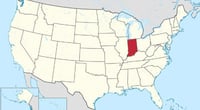
 Yellow Snowman |
  manchester |
  constant |
  Leapfrog Move |
  vibranto |
  Tora Tora |
  yellowbutter |
  Dolly |
  US Embassy |
  NYC saladbar |
  Finding Superfoods |
  lightyear |
  song bang |
  vexomo |
  Indiana Jones |
  meloncat |
  novapixel |
  mortrix |
  Esther 1983 |
  fortbliss |
  Moscow Kim |