

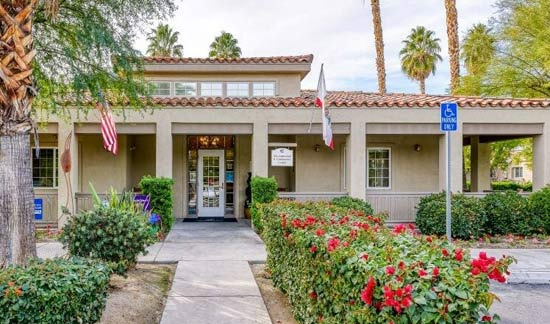
Walking around Palm Springs, you can feel that there is a large senior population. It is also common knowledge that assisted living facilities are quite prevalent.
This area has a desert climate, which is dry with strong sunlight and particularly warm winters. This is why seniors with arthritis often say, "It hurts less here." Rainy days are rare, and there are no worries about slippery snowy roads, so activity levels naturally increase, and many report feeling happier due to the sunshine.
As a result, many retirees move down from large cities like LA, San Diego, and Chicago, and during winter, the 'snowbird' pattern of Canadian grandmothers and Minnesota grandfathers coming down for a short stay is also common.
Thanks to this demand, there are more options for assisted living facilities than one might expect. They range from single-story buildings with cozy gardens to upscale resort-like places, and they generally include daily care such as meal provision, cleaning, medication management, and transportation support.
Many facilities are also connected to systems that allow for transitions to memory care or skilled nursing if needed. Community programs are active, offering chair yoga in the morning, painting classes at lunch, and games like Go and cards in the afternoon, with some places hosting small live music performances on weekends.
Points that seniors often inquire about include proximity to external hospitals, the presence of Korean staff, and whether pets are allowed. You might be curious about costs; assisted living in Palm Springs typically ranges from $4,000 to $7,000 per month.
Costs vary depending on room size, whether there is a private bathroom, and the level of programs offered, and if memory care or medical support is added, costs naturally increase. Some places are priced between $8,000 and $10,000, but those facilities are almost hotel-like.
However, they are generally slightly cheaper than in large cities, making them attractive to those who want to reduce living expenses after retirement while enjoying a warm climate. Of course, in summer, the heat can exceed 40 degrees, so some choose to escape to Phoenix or coastal cities, or move north for a 'dual life' during the summer.
However, considering winter, Palm Springs offers a combination of sunshine, a quiet environment, and convenient access to golf courses and shopping centers. The abundance of assisted living facilities is not just because there are many seniors, but because the environment itself is conducive to enjoying old age, making this city a retirement haven, resulting in many options and competition, which generally keeps the quality of facilities clean.
Ultimately, Palm Springs assisted living has a strong image of being a place where "even while receiving care in old age, life flows leisurely and warmly."
 CheolYoungmi




 neroyo |
 nivex85 |
 Old English |
 nixxon |
 LIZ Legal Information Blog |
 Star Blog |

 Sarah's Blog |
 Casa Mia |
 Korean Mom |
  My NYC |
  moo moo |
  Mr Oh |
  forevergee |
  festival |
  manchester |
  constant |
  Leapfrog Move |
  vibranto |
  Tora Tora |
  yellowbutter |
  Dolly |
  US Embassy |
  NYC saladbar |
  Finding Superfoods |
  lightyear |
  song bang |
  vexomo |
  Indiana Jones |