

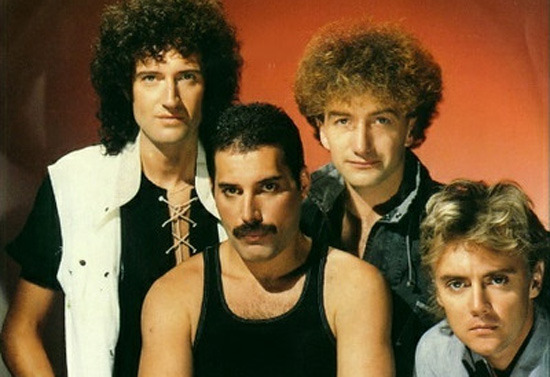
When talking about the British rock band Queen, there are always a few things that come up.
Isn't the name itself unusual? 'Queen'. It stood out even among other rock band names at the time.
It was not just cool; it had a provocative and symbolic feel to it.
Freddie Mercury was at the center of it all. On stage, he became a completely different person.
Despite his small stature, he exuded an overwhelming presence. This was not just about being a good singer.
It was a performance that combined the power to draw in the audience, the energy to dominate the stage, and emotional expression.
Even by today's standards, it doesn't feel outdated. In fact, it seems even more sophisticated.
The reason Queen's music is special is that it cannot be explained by just one genre. They are a rock band, but they don't just play rock.
They freely mix opera, ballads, hard rock, and pop. This is clearly evident in their iconic song, Bohemian Rhapsody.
Even though multiple genres are included in one song, it doesn't feel strange. Instead, it flows naturally.
The structure of this song itself is groundbreaking. There is no chorus, and it flows like a story.
Yet, people all over the world sing along. This was possible not just because it was an experiment, but because it had a high level of completeness.
Whether in Korea or the United States, it's rare to find a song that gets everyone singing along in karaoke like this.
Another characteristic is the overall capability of the members.
Typically, in a band, one person takes the lead while the others support, but Queen is different.
Brian May's guitar can be recognized by its unique tone, and Roger Taylor handles not only the drums but also vocals.
John Deacon is also an excellent songwriter. In fact, hit songs like 'Another One Bites the Dust' were created by the bassist. This team does not have a structure where one person leads; each member is a pillar. This makes their music more three-dimensional.
And there is an event that cannot be overlooked when discussing Queen: the death of Freddie Mercury. He passed away in 1991 due to complications from AIDS. Looking back now, the tragic aspect feels even more pronounced. Today, HIV/AIDS is a disease that, while not completely curable, can be treated and managed. With consistent medication, one can maintain a normal life.
This naturally leads to the thought: "Why couldn't such a wealthy and famous person receive treatment and survive?" This aspect resonates dramatically with many people. However, understanding the situation at the time clarifies things. The late 1980s and early 1990s were periods when treatments for AIDS had not advanced as they have now. Medications were limited, and, above all, the social stigma was very strong. The atmosphere was more about hiding the illness than addressing it. Mercury also did not disclose his condition until it was quite advanced.
Ultimately, this story is not simply about "money can't save you." It is a result of the limitations of the era, the level of medicine, and the social atmosphere all intertwined. Thus, his death remains symbolically significant.
Ironically, after his death, Queen's music was brought back into the spotlight even more. Especially, videos of live performances and the Live Aid stage are still talked about as legends. The energy remains timeless.
In summary, Queen is not just a band with a few hit songs.
Their experimental nature and completeness that transcends genres, the independent capabilities of each member, and the iconic presence of Freddie Mercury all combine to create a brand. With the addition of his life and death, this band has become a story beyond music.
So even now, listening to Queen feels like experiencing not just "good songs." It feels like listening to an entire era. That is perhaps why this band still feels alive.







 There Are Such Things in the World |
 Seattle - Emerald City |
 Next Year, Let's Become Rich |
 Strawberry Candy Smoothie |
 Happy Together 213 |
 Learn English Accurately |
 Tainami American Travel Story |
 Shintongbangtong Shin Naerin James Park |
 Miju Communication News Blog |
 rigid |
  Ohio Ohayoung Hello |
  U.S. Military Recruitment Information |
  You Turn Me On |
  DaeBak Electronics CNET |
  Anjollinya Blog |
  solid90 |
  elion |
  xylora |
  Study Abroad Life Know-How Tips |
  cheesepup |
  carpflow |
  mapsina |
  Softy |
  Mr. Largo |
  breezem |
  Omelet Rice for Strength |
  Vermont Capt |
  waltz |
  Shoot Me |