

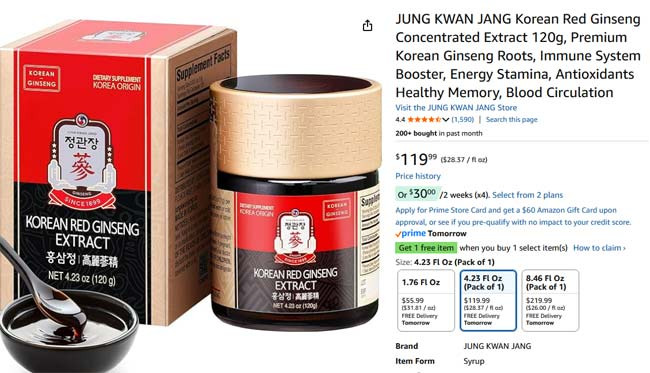
If you search for red ginseng on Amazon, you'll be amazed at the number of products available.
From Korean brands like Jeonggwanjang to capsules, powders, and jellies you've never heard of, the variety is endless.
What's even more surprising is the sales volume. Popular products sell thousands each month, and when combined, tens of thousands are consistently sold.
Who is buying so much of this? Is it really just Koreans?
At first, I thought the main customers would naturally be Korean expatriates or Asian people.
In fact, for Koreans, red ginseng is almost a staple health food. Gifts for parents, holiday presents, a pack when feeling tired—it's a familiar culture. In other Asian cultures like China and Vietnam, ginseng has long been known as a health food, so there is certainly some demand.
However, looking at the Amazon market, the scale of the story is different. The sales volume cannot be explained by just the Korean and Asian populations in the U.S.
A closer look at the reviews provides a hint. Many buyer names are typical American names, and most reviews say things like, "Energy is better," "Helps with fatigue," and "Good for immunity."
Wait? The main consumer base is more American than expected.
Why are Americans seeking red ginseng? The reason is simple.
The natural health supplement market in the U.S. is experiencing explosive growth.
Products like vitamins, probiotics, ashwagandha, and turmeric have already become commonplace. Red ginseng has established itself as a functional herb within this trend. Especially when keywords like energy, immunity, and stress relief are attached, many consumers show interest.
Another important change is the K-brand effect. In the past, ginseng was an unfamiliar Eastern herb, but now the name "Korean Red Ginseng" itself has become a brand. Just like Korean cosmetics, kimchi, and ramen, there is growing trust in Korean health foods. In fact, reviews often include phrases like, "Korean product so I trust it."
The price range also plays a role. While premium brands are expensive, there are many capsule products available on Amazon for around $20 to $40. For American consumers, trying a health supplement feels like spending about the same as a month's worth of coffee. It's a price point that allows for a low-risk start.
Interestingly, the purpose of purchase differs. In Korea, it's often consumed for stamina or for the health of parents, but in the U.S., it's a bit different. Office workers buy it for energy, athletes for performance support, and middle-aged individuals for immune management.
Red ginseng is being positioned not as a traditional health food but as a 'natural energy supplement.'
It is correct to view that a significant portion of the red ginseng sold on Amazon is purchased by American consumers, not Koreans. There is Asian demand, but the current sales scale signals that it has already entered the mainstream market.
What was once the bitter red ginseng that Koreans were forced to take as children is now something Americans are willingly seeking out and paying for.
Perhaps red ginseng is no longer just a traditional Korean food but is becoming a global health item.



 Tora Tora |
 neroyo |
 nivex85 |
 Old English |
 nixxon |
 eatontown blog |
 squidogame |
 Margarine Daebimama |
 cloudyday |
 round1 |
  Way to easy |
  musicque |
  road98 |
  Churros Train Conductor |
  gleeful |
  Burbank Lee |
  Olivia's Blog |
  Bushing Around Life |
  Active |
  Cherokee Rose |
  Kor. Master |
  Holey Moley |
  Conflite Teacher |
  Hodong Prince Over Flex |
  Mist inn |
  citrus pop |
  Onion Ring |
  phoenixia |
  viewtop |