

I still think about it sometimes.
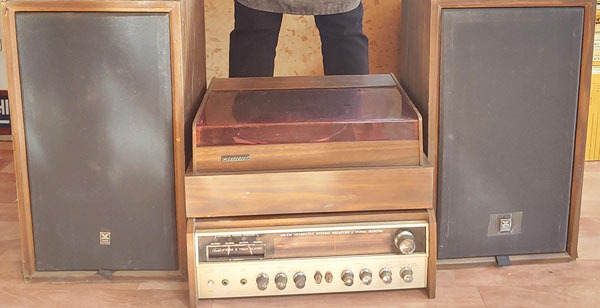
In my grandfather's house, there was a machine that looked like a low wooden cabinet.
When you opened the lid, a turntable with an arm emerged, and next to it was a radio dial.
We called it a 'turntable.'
In the early 1990s, when I was in elementary school, I visited my grandfather's house every weekend.
He was a quiet and gentle man, but his expression changed strangely in front of the turntable.
The way he opened the cabinet door and selected a record, dusting it off and carefully placing it on the turntable, and the silence before he dropped the needle.
The click as the needle touched the record, and the music flowed... I can never forget the atmosphere of that moment.
Mozart, Beethoven, Tchaikovsky...
The melodies of classical music quietly filled the house, and even as a child, it felt somehow special.
The turntable in my grandfather's house was the 'Taekwang Eroica.'
It was a symbol of pride in home appliances at that time.
With its dark walnut finish, metal dial, and square volume button,
when you opened the heavy, shiny lid, you could feel the word 'luxury' emanating from it.
It may look somewhat bulky and large now,
but back then, it was an item that everyone wanted to have as a symbol of an affluent home and an elegant life.
Until the early 1990s in Korea, the turntable was not just a music device.
It was a wedding gift item, the centerpiece of the living room, and a high-end cultural item used to entertain guests with classical or pop music.
Domestic electronics companies like Taekwang, Geumseong, Samsung, and Daewoo all released wooden turntables, and among them, the 'Taekwang Eroica' was regarded as a high-end model.
The 'combi turntable' that could play both cassette tapes and LPs was the pinnacle of technology at the time, and just having the lid open changed the atmosphere of the home.
However, as time passed, turntables began to be absorbed into black electronics.
TVs, videos, audio systems, and even speakers were bundled together in black, and the elegant wooden cabinet form at the center of the home gradually disappeared, replaced by monotone functional machines.
The once-common turntable became a relic of the past, and LP records were pushed deep into storage, while the act of opening the turntable lid was gradually forgotten.
Then, in the 2000s, as everything turned digital, turntables began to disappear.
MP3s, CDs, USBs, and Bluetooth.
With the push of a button, thousands of songs play automatically, transmitted through wireless speakers, and a small device holds years' worth of music.
Of course, it was convenient. But somewhere, the 'process of listening to music' was lost.
The turntable was not just a machine for playing music.
It involved a process of preparing and respecting 'listening time'.
Taking out a record and placing it on the turntable, carefully lowering the needle was not about consuming music, but rather a ritual of 'welcoming' music.
Through that process, music became not just something you heard, but a presence that filled the entire space.
Now those turntables are gathering dust at flea markets, in the corners of vintage shops, or at the side of furniture disposal sites.
But to me, a turntable is not just an old machine.
It is the emotion of my childhood, the sunlight of weekend afternoons filled with classical music, my grandfather's smile, and a small stage where the dignity of our family quietly resonated.
Now, with just a smartphone, all music is at my fingertips, but I sometimes long for those days.



 novapixel |
 Peter Pan Pet |
 horse |
 Sunset Oregon |
 daisypat |
 squidogame |
 Margarine Daebimama |
 eatontown blog |
 cloudyday |
 Google Idea |
  Korean Mom |
  My NYC |
  moo moo |
  Mr Oh |
  forevergee |
  festival |
  manchester |
  constant |
  Leapfrog Move |
  vibranto |
  Tora Tora |
  yellowbutter |
  Dolly |
  US Embassy |
  NYC saladbar |
  Finding Superfoods |
  lightyear |
  song bang |
  vexomo |
  Indiana Jones |