

Some days, I look forward to what the YouTube algorithm will show me, while other days, I get frustrated when it only brings up political discussions.
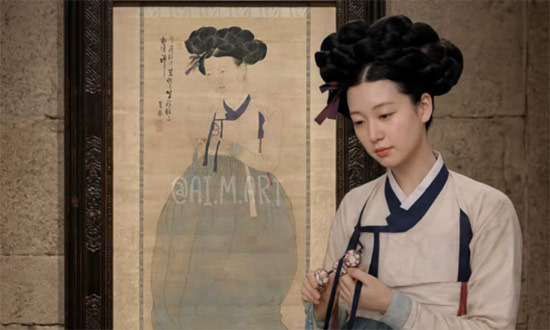
And sometimes, it can be quite useful. Recently, I came across a video in my feed that featured AI bringing characters from classic paintings to life.
I've seen countless AI videos lately. But this one was not just about technology; it was a reinterpretation.
The video starts with a beauty portrait. It feels like the woman from the Joseon Dynasty painting is stepping out of the frame. The serene and composed atmosphere remains, but her eyes move, and you can sense her breathing. It's not just a "similar level" of creation; it feels as natural as a real person depicted in the painting.The Mona Lisa was a high-expectation case. Everyone knows that face. But the expression the AI created is truly subtle.
It seems like she might be smiling, but it's ambiguous, and that ambiguity comes across as a real human face.
At this point, it's clear that this is not just simple video processing. Technically, it extracts the nuances of expression from a static image, reconstructs it in 3D, and then generates movement reflecting the historical context.
If this had been just five years ago, such work would have only been possible in a Pixar-level studio with a multi-million dollar setup. Now, it can be seen in a single YouTube video.
The portrait of Madame X is elegant and cold. The slight sense of distance is preserved. The golden splendor of Adele Bloch-Bauer comes to life in a way that is not diminished but rather takes on a three-dimensional quality. The final shot of Sage Blue Marilyn blends the strong colors of pop art with a real person, creating a completely different dimension.
AI is not just creating faces. It is also reading the aesthetic sensibilities, class, and atmosphere of that era.
This is the part that truly surprised me. An AI that understands context is different.
Let's think from the perspective of the art museum industry. The experience of seeing the Mona Lisa at the Louvre is actually quite underwhelming.It's behind thick bulletproof glass, crowded with people, and the actual painting is smaller than you might expect.
But what if this technology is perfected? It will be possible to see the Mona Lisa breathing on a 4K screen from home.
Does that diminish the value of the original, or does it open up art to more people? This is a topic for debate. But the direction is already set.
The framework of AI as a "tool" needs to be updated. What this video shows is that AI is interpreting art.Decisions about what expression to give, how to move, and how to capture the essence of that era... all of these choices are coming from AI.
Is it scary? Honestly, a little bit. But the ones who win are those who try it first instead of fearing technology.
Wireless communication, silent films, radio broadcasting, television—all of these started that way and evolved.
We are approaching a turning point where art is transitioning to being "experienced," and I have no intention of falling behind while just debating philosophy in the face of that wave.
 SandwichSurf







 Let's Be Like a Salt-like City Person |
 Springs Korea |
 US Legal Consultation on Trials |
 Study Abroad Life Know-How Tips |
 Best Frozen Yogurt |
 Anna Life |
 Spaghetti Flying Religion |
 Round and Round Children's Song Kingdom |
 My Love DS |
 Healthy Local Fresh Information |
  molten |
  Way to easy |
  intact |
  Always Dreaming of Big Success |
  happy 9 |
  Park M.Y. |
  tredon |
  Poppin News |
  metsoo |
  dewyo |
  Casa Mia |
  Asparagus Blog |
  dorange |
  hiddenkong |
  some fame |
  Godory Life |
  Lime Juice |
  French fries |
  Rynex |