

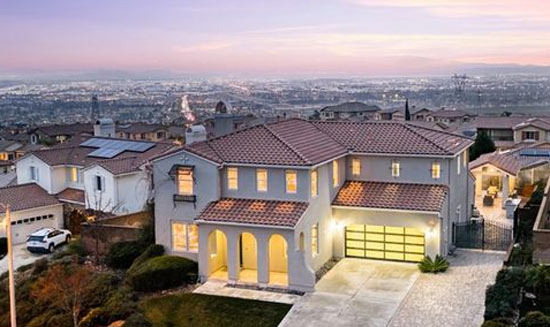
Looking at the case of preparing for retirement through real estate in Southern California, one might think it was just luck, but it is a story of well-prepared individuals when you look at the trends.
A Korean family residing in Rancho Cucamonga, San Bernardino County, received about $1 million in inheritance in 2011 and set up a long-term retirement plan. At that time, the housing market had not fully recovered from the financial crisis, and there were relatively many single-family homes available in the early $300,000 range in the outskirts of Southern California.
2011 was a time when the Southern California housing market was close to its lowest point after the financial crisis. The median price of single-family homes in Rancho Cucamonga was around $280,000 to $320,000 at that time. The market then rose in three stages.
The first stage was from 2012 to 2019, characterized by low interest rates and economic recovery. During this period, prices rose to around $500,000.
The second stage was from 2020 to early 2022, marked by ultra-low interest rates and increased migration demand. Prices skyrocketed during this time, with transactions exceeding $700,000 becoming common.
This family aimed for stable cash flow rather than investment purposes. They used part of the inheritance to purchase three homes in the $300,000 range in 2012, with one for personal residence and the other two for rental.
At that time, Rancho Cucamonga was known for its stable school district and relatively good safety, with decent access to LA via the 210 freeway, making it a consistently desirable area for residents. They chose a location suitable for long-term holding rather than short-term price gains.
As time passed, the market situation changed significantly.
With population growth across Southern California, a shortage of housing supply, and a period of low interest rates, housing prices steadily increased. Currently, homes that were purchased for around $300,000 have risen to about $750,000, more than doubling in asset value. Including the home they reside in, their real estate assets now exceed approximately $2 million.
There have also been changes in cash flow.
With rising rents and increased market demand, the monthly rental income from the two properties is now around $6,400. While they need to consider property taxes, maintenance costs, and vacancy risks, if they are in a paid-off state, a significant portion of their living expenses can be covered by rental income. The couple, already retired, has maintained cash flow in addition to their monthly pension of about $4,000, greatly enhancing their retirement stability.
This case may seem special, but the key lies in timing and strategy.
2011 was a time when the market was close to its bottom, and instead of excessive leverage, they chose to buy with cash and hold long-term. Additionally, selecting a residential area with steady demand rather than a popular urban center also helped in maintaining stable rental operations.
Of course, real estate investment does not always yield the same results. There are various variables such as rising interest rates, tax burdens, repair costs, and economic fluctuations. Nevertheless, this case can be seen as a realistic example showing that residential real estate in Southern California can simultaneously generate asset growth and cash flow over the long term.
From the perspective of retirement preparation, what ultimately matters may be the choice to endure for a long time at a manageable level, rather than flashy investment techniques at the right time.







 sparkling |
 oh my salami |
 saffronroute |
 You Only Live Once |
 Texas Real Estate Blog |
 Star Way |
 CA Real Estate |
 Choi Cho |
 some fame |
 US Home Buying Information Home Insurance |
  Korean Mom |
  My NYC |
  moo moo |
  Mr Oh |
  forevergee |
  festival |
  manchester |
  constant |
  Leapfrog Move |
  vibranto |
  Tora Tora |
  yellowbutter |
  Dolly |
  US Embassy |
  NYC saladbar |
  Finding Superfoods |
  lightyear |
  song bang |
  vexomo |
  Indiana Jones |