

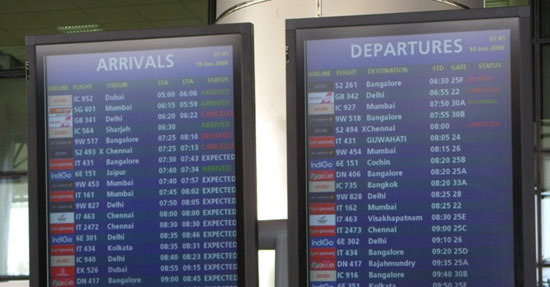
If you fly a lot in the US, you've probably experienced a red-eye flight cancellation at least once.
A night flight from LA to New York, saving time by waking up upon arrival.
I believed in that scenario and ended up getting hit hard.
Right before departure, there was a delay, and it ultimately got canceled.
The reason was just one line — "Weather conditions."
"What the fxxx?!" I had just left home after telling my wife I'd be back soon, and now I have to return home.
But the sky in LA is clear, so how can it be a weather issue? However, it turns out this is a more complicated situation than it seems.
And the more important fact is that in this situation, the airline is legally not required to give you anything.
Flight cancellations are not just about the departure airport. New York's JFK or LaGuardia can get backed up due to unpredictable weather in early March, causing a domino effect of delays.Blizzards, storms, and repeated delays can lead to airport congestion.. just one of these issues can cause flights departing from LA to be canceled.
It doesn't matter if the sky in LA is clear. If the entire system is backed up, my flight can't take off.
So when you complain to the counter staff, the response is always the same.
"Due to weather, we are unable to operate this flight."
This is not incorrect. It's just how the system is structured.
However, many people misunderstand this. If you've traveled in Europe, you might think, "Can't I get compensation for delays?"
No. The US is different.
According to US DOT (Department of Transportation) regulations, if the airline is not at fault — due to weather, airport control, or natural disasters — there is no obligation for cash compensation.
From the airline's perspective, if they can say, "It's not our fault," that's the end of it.
Airline fault means "the flight was delayed or canceled due to the airline's responsibility."
This typically includes issues like aircraft maintenance problems, crew scheduling issues, overbooking, or internal operational errors.
For example, if a defect is found during an aircraft inspection, or if a crew member exceeds their regulated working hours and cannot be deployed, these are typical scenarios.
In these cases, since it's within the airline's control, compensation is applicable. Usually, hotel, meal vouchers, and rebooking on another flight are standard, and depending on the situation, cash or credit compensation may also be provided.
However, if the cancellation is due to weather conditions, there is no compensation. The only thing you can get is essentially a rebooking. They will change you to the next available flight.
The problem is that the demand for the LA–New York route is so high that securing an alternative flight is not easy.
You end up spending double the money and losing a whole day or two of your schedule.
Hotel or meal vouchers? Officially, there is no obligation to provide them due to weather. However, depending on the situation, airlines may voluntarily offer them.So it's better for your mental health not to expect anything. If you get something, it's a bonus; if not, that's just how it is.
So I think red-eyes are definitely an attractive option. They save time and allow you to keep your daytime schedule.But if something goes wrong, a whole day can disappear. And that's without any compensation.
This is the reality of the US airline system. Weather is nobody's fault, so that's the logic.
I don't think this is wrong. It's just that if you don't know the rules and get caught, it feels unfair.







 Taco Seattle |
 Mr Song Song |
 Living Economy Information Blog |
 Blog Korea |
 Medical Latest Trends News |
 All About Cars |
 Korean News American Blog |
 Piano Teacher Blog |
 humpday sonata |
  Conflite Teacher |
  summita |
  Ari Songhan American Immigration Life |
  marketbox |
  Investment Campus Home Ownership |
  yentra |
  Iowa Egen Aunt |
  donut33 |
  gravity |
  American Golf Course Travelogue |
  There Are Such Things in the World |
  Agenda Center |
  digital |
  timemachine |
  Starry Eyes |
  Desert King |
  Texas Real Estate Blog |
  U.S. Retirement Pension Information |
  Seattle - Emerald City |
  Texas Migration Story |