

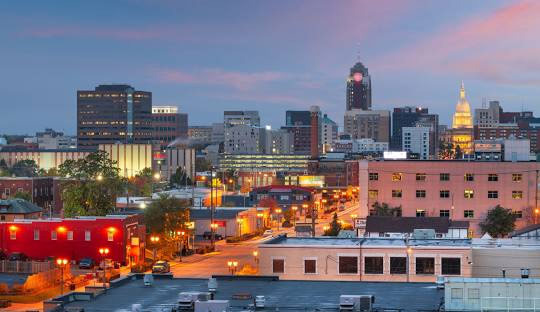
In fact, this city was not originally the capital. Established in 1835, it became the administrative center of Michigan when the capital moved from Detroit in 1847. The purpose was to disperse Detroit's political influence and balance it towards the central part of the state. It was later incorporated as a city in 1859, and as the automobile industry developed, the city began to grow significantly.
Lansing is located in southern Michigan, at the confluence of the Grand River and the Red Cedar River. It is about 160 km northwest of Detroit and forms a metropolitan area with the neighboring city of East Lansing. As of 2020, Lansing has a population of approximately 112,000, and when including the metropolitan area, about 540,000 residents live there.
The public sector is the largest employer due to the concentration of state government agencies. The administrative departments of the Michigan legislature, the Supreme Court, and state government offices are all located in Lansing. Additionally, the automobile industry and educational institutions are significant pillars of the local economy. Once famous as the home of Oldsmobile, the city has a deep tradition in automobile manufacturing. As of 2015, the average household income was reported to be about $54,485. While this is below the national average, it can be considered a moderate level within Michigan.
One of Lansing's greatest prides is its educational infrastructure. Michigan State University, located in the neighboring city of East Lansing, is a large public research university with over 50,000 students. It is nationally renowned in sports, research, medicine, and agriculture, contributing to a youthful and vibrant atmosphere in the city. Additionally, Lansing Community College offers vocational training and various degree programs, expanding educational opportunities for local residents.
As an administrative center, the city is rich in cultural and historical landmarks. The Michigan State Capitol, completed in 1879, is an iconic building in Lansing, and interior tours are available. The Michigan History Museum showcases exhibitions about the state's history and culture, while the Olds Transportation Museum features artifacts related to Lansing's automotive industry and Oldsmobile.
Lansing has many parks and recreational spaces, making it a pleasant place to live. Various festivals and cultural events are frequently held, keeping the local community active. While it is the capital, the cost of living is relatively affordable compared to larger cities, making it a suitable place for families.
As a transportation hub, highways and railroads intersect, and the Capital Region International Airport makes domestic and international travel convenient. Long-distance buses like Greyhound are also available, enhancing accessibility.
Lansing is more than just an administrative city with state government; it has played a central role in politics, education, and the automotive industry. With the vibrancy brought by the university, rich history and culture, and the stability of being the capital, it is a city with diverse attractions. While it may not have the grandeur of a large industrial city like Detroit, Lansing has steadily grown, serving as the heart of Michigan.






 fortbliss |
 Folding Instructions |
 yentra |
 Cali M Law Group |
 quanta7 |
 sugartrail |
 raspberry7 |
 toffee |
 mygoddess blog |
  Korean Mom |
  My NYC |
  moo moo |
  Mr Oh |
  forevergee |
  festival |
  manchester |
  constant |
  Leapfrog Move |
  vibranto |
  Tora Tora |
  yellowbutter |
  Dolly |
  US Embassy |
  NYC saladbar |
  Finding Superfoods |
  lightyear |
  song bang |
  vexomo |
  Indiana Jones |