

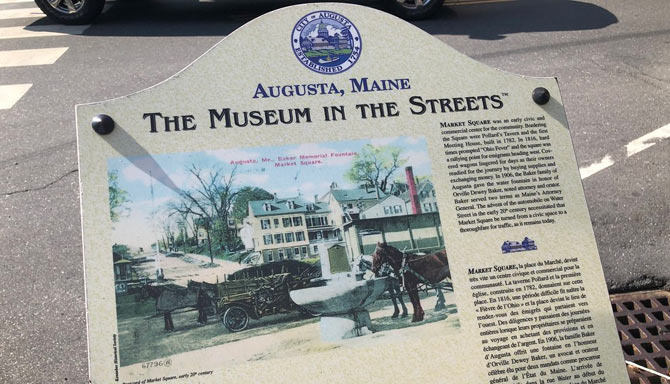
Traveling through Augusta, Maine, you quickly realize it is not just a simple administrative center. Although it appears to be a quiet and tidy city, as you stroll slowly through the streets, unique exhibitions that seem to bring history to life catch your eye.
It is 'The Museum in the Streets', literally a 'museum in the streets'. This project is a citizen-participatory history program that transforms Augusta's old streets and buildings into a living exhibition space. Actual photographs, events, figures, and stories of places from the past are displayed on building walls and signs next to sidewalks, allowing you to naturally encounter history as you walk through the city.
The first panel I encountered was at the entrance of a bridge near the Kennebec River. The sign featured a black-and-white photo showing how prosperous the lumber industry was along this river in the mid-19th century. At that time, Augusta was a major center for logging and shipbuilding in Maine. The image of logs floating on the river and the strong arms and smiles of workers transporting wood was striking.
As I gazed at the now-quiet river, imagining the bustling scene from the photo, I felt a strange overlap of time. After walking a few blocks, another sign caught my eye next to an old brick building. This time, it depicted the downtown area of Augusta in the early 1900s. Now a street lined with cafes and small bookstores, back then it was filled with horse-drawn carriages, men wearing bowler hats, and a sign that read 'General Store'. Seeing the same location from 100 years ago evoked a peculiar emotion.
It felt as if the present and the past coexisted in the same space. Below the sign was a short description: "This street was once the center of daily life and commerce for the citizens of Augusta. Now, a new generation walks the same path." The moment I read the sentence, I felt as if I had become a part of that street. The charm of the 'museum in the streets' lies here. It is not just a simple exhibition; the place itself is connected to history. Without having to go far to a gallery, every step reveals a story.
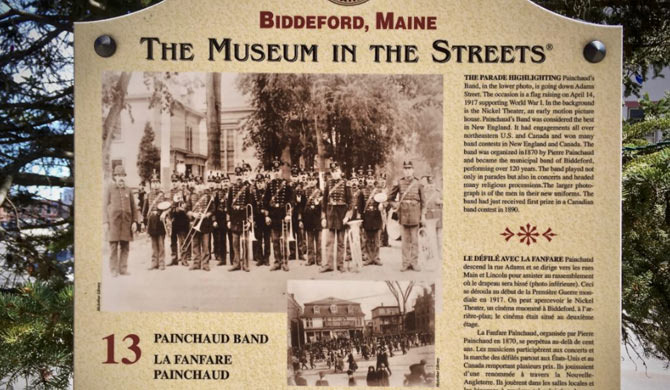
As I walked through the city center, there were several panels near the statehouse. In front of the Maine State House, there was an exhibition explaining why this city was designated as the state capital in 1832, along with photos from that time of the construction process. The early statehouse was a much simpler building, lacking the golden dome. Over time, the building expanded and became a symbol of Maine politics.
On one side, there was a group photo of the governor and legislators from that time, all wearing stiff expressions, yet there was a sense of pride in their ambition to establish a new state. Personally, the most interesting panel was near the old train station. Now designed as a quiet park, in the late 1800s it was a bustling hub of transportation with trains and freight boats coming in and out of Augusta. The photo from that time captured a steam locomotive puffing smoke as it crossed a bridge by the river.
Below it was the phrase, "The journeys of countless people who departed from here built Maine's industry." I sat on a bench for a moment, reflecting on that sentence, recalling the quiet present and the busy past of this city. Augusta's 'The Museum in the Streets' may not be large, but it is sincere. There are no flashy lights or grand announcements, but instead, the city itself becomes the exhibition space. Each sign is not just an explanation but a time capsule filled with Augusta's memories.
Everyone who walks that path may feel differently, but everyone has an experience that connects them to a piece of this city. Interestingly, this project is a result of collaboration between local residents, historians, and students. The fact that the city's past was recorded not by outsiders but by the people who live here adds greater significance.
A sentence on one of the riverside signs caught my eye: "We wanted to tell the story of this city to those who walk this street." Augusta's 'The Museum in the Streets' is precisely that kind of space.





 cookiefox |
 milkyotter |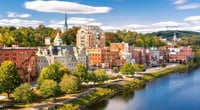
 US Regional Information Blog |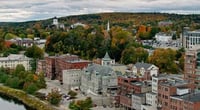

 Tonky |
  viroma |
  cookie |
  Live and that's it |
  Alright Twain |
  eatontown blog |
  HAWAII Korean Church News |
  Amore |
  linex |
  Balancework |
  laro90 |
  MEDBIO American Doctor Blog |
  SWAT TEAM BLK |
  DREAM BIG |
  frostbite |
  330 Forever My Love |
  El Dorado |
  dralix58 |
  Gorama Round |
  Skydiving |