

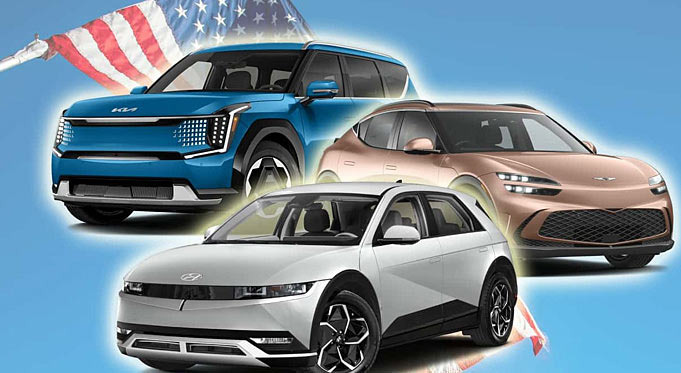
Last weekend, while driving along the PCH near Long Beach, I passed by a Toyota dealership.
The parking lot was packed with new cars.
I thought, "There seems to be a lot of inventory, maybe there are good deals?" so I decided to take a look...
I saw a RAV4's window sticker and just walked out. With some options added, it was well over $45,000.
A few years ago, you could get a pretty decent car for that price, but now that's just the "base" price.
Is there really no more sweet deals like "Candy" from the lyrics of H.O.T.?
The average manufacturer's suggested retail price (MSRP) for new cars in the U.S. has surpassed $50,000.
It's said to be about 30% higher compared to 2019, haha.
Even with discounts or incentives, the out-the-door price has crossed $50,000 for the first time.
According to J.D. Power data, the average monthly payment for new cars has also surpassed $800 for the first time.
$800... that used to be enough to buy a BMW X5 five years ago.
One in five new loans has a monthly payment exceeding $1,000...
Living in California now means your paycheck disappears quickly between rent and car payments.
To manage these prices, people are opting to extend their loan terms.
The current average loan term is 68.8 months, and the proportion of long-term loans over 84 months (7 years) is 11.7%, nearly double that of 2019.
In seven years, a child could graduate elementary school, but you'd still be paying off the car.
The delinquency rate is also concerning. According to the Philadelphia Fed, the rate of serious delinquencies over 90 days has risen to 8.6%.
This is comparable to the levels seen during the 2008-2009 financial crisis, so it's not something to take lightly.
Fundamentally, the speed of wage growth is not keeping up with the rise in car prices.
The first car I drove when I came to the U.S. was a Corolla. It was perfect for commuting without a financial burden, but now that option has disappeared.
The last model under $20,000, the Nissan Versa, was discontinued last December.
The Mitsubishi Mirage, Kia Rio, Hyundai Accent, and Chevrolet Spark have all exited the U.S. market.
The industry explains that "consumers don't want small cars," but on the other hand, manufacturers have also streamlined their small car lineups to focus on higher-margin SUVs.
In fact, SUVs and light trucks account for nearly 80% of total sales, with crossovers like the Honda CR-V making up almost half of all sales. Just ten years ago, the ratio of passenger cars to light trucks was similar, but the market structure has completely changed.
Living in California without a car is nearly impossible. Most people need a car to commute, and the coverage of the Metro Blue Line is very limited. Ultimately, a car is a necessity, not a choice, but with prices rising so much, what happens next?
Surveys show that prospective car buyers cite high new car prices as the biggest obstacle. Yet, manufacturers are expected to maintain a strategy focused on premium models for the time being. Because the margins are good.
If this continues, it will inevitably lead to a long-term decrease in new buyers entering the market. Last year, U.S. auto sales were 16.2 million, which was good, but this year is projected to slightly decrease to 16 million, which seems related to this trend.
It's common to change cars every 6-8 years, but many people are reportedly shocked by the price tags when they finally visit a dealer after a long time.
I was one of them. If you don't need to change your car right now, it might be wise to wait a bit longer and watch the market.
And if you decide to buy, be sure to consider not just the monthly payment, but also the total repayment amount, loan term, and the opportunity cost of that money.
A car is an asset that loses value the moment you drive it. There is no car that can beat depreciation. I believe that smart spending is more important now than ever.






 forevergee |
 mortrix |
 cherrydino |
 victoria 68 |
 American Man in a Mask |
 Korean Blog |
 Coastal city |
 Sammy Beach |
 Key spots |
 Tonky |
  viroma |
  cookie |
  Live and that's it |
  Alright Twain |
  eatontown blog |
  HAWAII Korean Church News |
  Amore |
  linex |
  Balancework |
  laro90 |
  MEDBIO American Doctor Blog |
  SWAT TEAM BLK |
  DREAM BIG |
  frostbite |
  330 Forever My Love |
  El Dorado |
  dralix58 |
  Gorama Round |
  Skydiving |