
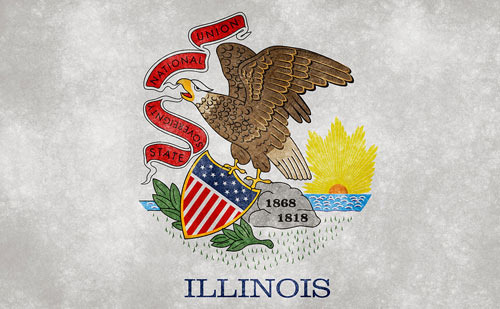
The Illinois state flag symbolizes the state's identity and history, and the current design has undergone several changes to reach its present form. The history of the Illinois state flag reflects the pride and identity of the state, with each design element carrying deep meaning.
The Early History of the Illinois State Flag
Illinois became the 21st state of the United States in 1818, but it was not until the 20th century that an official state flag was established.
- 1915: During a time when the establishment of state flags was popular across the United States, Illinois decided to adopt an official state flag.
- Initial Design: The flag designed by a female artist named Dayna Burchell was selected. This flag featured the state seal at its center, surrounded by the phrase "State Sovereignty, National Union."
However, the initial flag was criticized for being plain, with many opinions stating it lacked uniqueness compared to other state flags.
The Origin of the Current Flag Design
In 1969, a request for redesigning the state flag was made. This was due to the issue that the initial flag could not be easily distinguished from other flags at public offices or events.
- Design Change: Lucy Derwent proposed a new design, which was adopted as the current flag.
- State Seal at the Center: The state seal remains at the center of the state flag. The seal includes elements symbolizing the spirit and values of Illinois, with an eagle holding a shield.
Symbolic Elements of the Flag
The design elements included in the Illinois state flag each carry unique meanings.
1) Eagle
- Symbol: The eagle, a national symbol of the United States, represents Illinois' bond with the federation.
- Ribbon: The ribbon held by the eagle bears the state motto, "State Sovereignty, National Union".
- Meaning Change: The phrase "State Sovereignty" is written smaller, while "National Union" is larger, emphasizing loyalty to the federation. This reflects Illinois' stance towards the federation after the American Civil War.
2) Shield and Sun
- Shield: The shield features the American flag, symbolizing Illinois' commitment to uphold American values and the Constitution.
- Sun: The rising sun behind the shield signifies hope and new beginnings.
3) Dates and Rock
- Dates: Below the shield are two dates, 1818 (the year Illinois joined the United States) and 1868 (the year the current seal was established).
- Rock: The rock on which the eagle stands symbolizes the stability and strength of the state.
4) The Word "Illinois"
- In the 1969 revised design, the word "Illinois" was added to the bottom of the flag to distinguish it from other state flags.
Reinterpretation and Modern Significance of the Flag
The Illinois state flag may appear to be a simple design, but the elements contained within it symbolically represent the state's history and values.
- Sovereignty and Unity: The motto "State Sovereignty, National Union" conveys that Illinois seeks to be respected for its sovereignty while harmonizing within the larger framework of the United States.
- Diversity and Solidarity: Illinois is a state where agriculture, industry, and culture converge, and the flag reflects the identity of the state that embraces this diversity.
The Impact of the Illinois State Flag
The Illinois state flag is used in various settings, including national events, local festivals, and sports events, enhancing the state's symbolism. Particularly, due to the strong imagery of the eagle, shield, and sun, it is widely recognized as a representative symbol of the state.
Additionally, the flag serves as an important resource in the education of the state's history, instilling pride in the residents of Illinois.
The Illinois state flag is a powerful symbol that transcends simple design, encapsulating the state's history and values. The elements contained within it commemorate the state's past and embody hope for the future, establishing it as an important symbol representing the state.







 Khan Film Blog Production |
 Illinois Mom |
 Rice Shop Uncle BLOG |
 Enjoyable American Life Diary |
 allstar realty |
  Anytime Journey |
  Mrs. Duluth |
  jaxter |
  Atlanta Mama |
  Baguette Blog |
  US Embassy |
  Korean Mom |
  My NYC |
  moo moo |
  Mr Oh |
  forevergee |
  festival |
  manchester |
  constant |
  Leapfrog Move |
  vibranto |
  Tora Tora |
  yellowbutter |
  Dolly |
  NYC saladbar |