
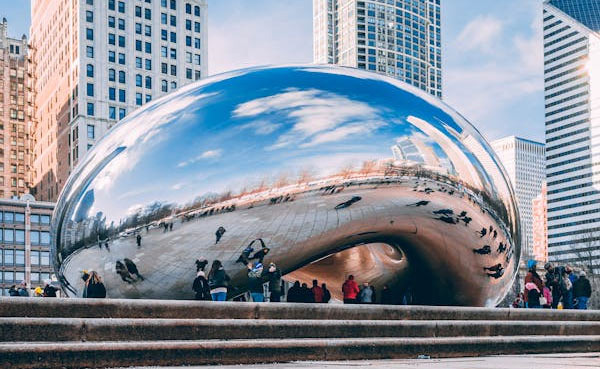
Chicago Bean, officially named Cloud Gate, is a landmark representing Chicago and an iconic piece of art in Millennium Park. This unique sculpture has become a beloved spot for both tourists visiting the city and local residents, serving as a hub for various activities such as photography, strolling, and enjoying the urban landscape.
The Chicago Bean was designed by British artist Anish Kapoor in 2004 and was officially unveiled in 2006. This work was created as part of a large urban renewal project in the city of Chicago. Millennium Park was originally a site for railroads and parking lots, reimagined as a park, with the intention of installing Cloud Gate at its center to create a space where modern art, nature, and the city blend together.
Anish Kapoor is known for large-scale public art projects, emphasizing the symbolism of his works and audience participation. Through Cloud Gate, he created a medium that connects the city's sky, surrounding landscape, and viewers into one.
Cloud Gate is shaped like a giant kidney bean, earning it the nickname "Chicago Bean." This sculpture has the following features:
- Size: Approximately 33 feet (10 meters) tall, 66 feet (20 meters) long, 42 feet (13 meters) wide, and weighs about 110 tons.
- Material: Made from 168 stainless steel panels seamlessly joined together, boasting a perfectly reflective mirror-like surface.
- Manufacturing Process: The panels were welded and meticulously polished to ensure that seams are invisible. This process was technically very challenging, and the initial production costs actually exceeded the budget.
The unique shape and surface of Cloud Gate distort reflections of the surrounding urban landscape, sky, and visitors. This characteristic encourages interaction with the artwork, providing constantly new visual experiences.
The name "Cloud Gate" comes from the arch shape at the bottom center of the piece, allowing passage underneath. This arched space creates an effect where the sky and clouds of Chicago are reflected on the surface of the artwork, resembling a gate. True to its name, Cloud Gate serves as a portal framing the sky and city of Chicago.
Cloud Gate is located at the center of Millennium Park, well-connected to other major attractions.
- Crown Fountain: A fountain equipped with digital screens and water play features.
- Jay Pritzker Pavilion: An outdoor concert hall designed by Frank Gehry.
- Connection to Randolph Street: The park and downtown are seamlessly connected, providing excellent accessibility for visitors.
As Millennium Park is a space actively used by both locals and tourists, Cloud Gate serves as the landmark of this park.
Cloud Gate is not just a sculpture but symbolizes the relationship between Chicago, contemporary art, and the city and its people.
- Identity of Chicago: Chicago is a hub of modern architecture and art, and Cloud Gate represents the creativity and innovation of the city.
- Art for Everyone: The piece is public art accessible to all, making it special for its direct interaction with viewers.
- Photo Spot: Thanks to its reflective surface, visitors can take photos from various angles, enjoying both art and play.
- Global Landmark: Cloud Gate has established itself as a globally recognized tourist attraction, beyond just a local site.
- Optimal Visiting Time: Early morning or evening when there are relatively fewer visitors allows for a more leisurely appreciation.
- Seasonal Appeal: In winter, the surroundings are covered in snow, providing a unique landscape, while in summer, it can be enjoyed alongside various events in Millennium Park.
- Photo Spot: Taking a photo looking up from beneath the bean creates a unique effect.
The Chicago Bean is not just a single piece of art but has a significant impact on Chicago's urban culture, tourism, and economy. Millions of visitors come here each year, contributing significantly to the local economy.





 Khan Film Blog Production |
 Rice Shop Uncle BLOG |
 Illinois Mom |
 allstar realty |
 Nanana Nanana Nanana |
  Korean Mom |
  My NYC |
  moo moo |
  Mr Oh |
  forevergee |
  festival |
  manchester |
  constant |
  Leapfrog Move |
  vibranto |
  Tora Tora |
  yellowbutter |
  Dolly |
  US Embassy |
  NYC saladbar |
  Finding Superfoods |
  lightyear |
  song bang |
  vexomo |
  Indiana Jones |