
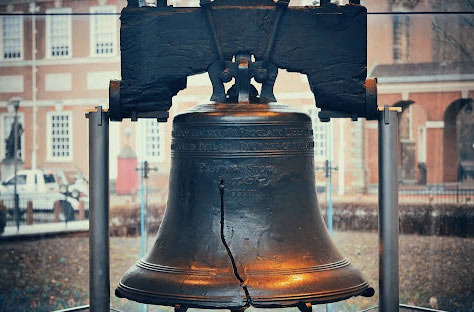
The history of this bell dates back to 1752. At that time, the Pennsylvania Assembly ordered a large bell for the State House from the Whitechapel Bell Foundry in London, England. However, as soon as the bell arrived in Philadelphia, it cracked during a test strike. Since it would take a long time to reorder from England, local artisans John Pass and John Stow recast it themselves, resulting in the Liberty Bell we know today. The names of the two artisans are inscribed on the bell, and their marks can still be seen up close.
The most historic moment was on July 8, 1776. A few days after the Declaration of Independence was approved in Independence Hall, this bell rang out to announce the news of independence to the citizens. Its ringing was not just a sound but a declaration marking the beginning of freedom from oppression. Subsequently, this bell became a symbol of many movements advocating for freedom and equality, including the American Revolutionary War, the 19th-century abolition movement, and the women's suffrage movement.
However, the Liberty Bell took on its 'cracked appearance' in the mid-19th century. Although there are no official records, it is said that a significant crack occurred during a celebration for George Washington's birthday in 1846. After that, the bell could no longer sound, and its 'cracked appearance' became an icon symbolizing the imperfect reality of freedom. Ironically, that imperfection conveyed an even stronger message.
Today, the Liberty Bell is displayed at the Liberty Bell Center. The address is 526 Market Street, Philadelphia, PA 19106, directly across from Independence Hall. This place is a modern exhibition space surrounded by glass, and anyone can enter for free. During peak season, the waiting line can be long, but generally, the turnover is quite fast. Inside, there are photos, videos, and panels explaining the history of the bell and the spirit of independence, deepening the understanding of American history. Especially, the structure allows a clear view of Independence Hall right behind the bell, creating a visual connection between the past and the present.
The inscription on the Liberty Bell resonates deeply with many people. "Proclaim Liberty Throughout All the Land Unto All the Inhabitants Thereof" means "Proclaim freedom to all the inhabitants of the land" and is a quote from Leviticus 25:10 in the Bible. Originally inscribed to symbolize the abolition of slavery and citizens' rights during colonial times, it later evolved into a symbol of American independence, human rights movements, and democracy. The fact that Martin Luther King Jr. quoted this phrase while leading the civil rights movement is in the same context.
Transportation is also convenient. If you take the SEPTA Market-Frankford Line (Blue Line) and get off at 5th Street/Independence Hall station, it takes just 2 minutes on foot to arrive, and buses 9, 21, 42, and 47 pass nearby. If you are driving, you can use the parking lot at the Independence Visitor Center right next door.
Operating hours are generally from 9 AM to 5 PM, although there may be slight variations depending on the season. Admission is free, but be prepared to wait in line during the busy summer months. However, it is well worth the wait. The cracked bell you encounter up close is not just an artifact but a testament to the time and sacrifices made by humanity for freedom.
When you face the Liberty Bell in Philadelphia, the word 'freedom' no longer feels abstract. That worn and cracked piece of metal symbolizes imperfect freedom, yet it embodies the human will to strive for progress. Even today, thousands of visitors quietly stand in front of it, taking photos, while some close their eyes and reflect on the meaning of freedom.
The ringing has stopped, but the message still resonates.





 Northeastern |
 Nationally Certified Lightning Charcoal Review |
 American Grape Shine Muscat |
 U.S. Weather Bureau News |
 sparkling |
  manchester |
  constant |
  Leapfrog Move |
  vibranto |
  Tora Tora |
  yellowbutter |
  Dolly |
  US Embassy |
  NYC saladbar |
  Finding Superfoods |
  lightyear |
  song bang |
  vexomo |
  Indiana Jones |
  meloncat |
  novapixel |
  mortrix |
  Esther 1983 |
  fortbliss |
  Moscow Kim |