

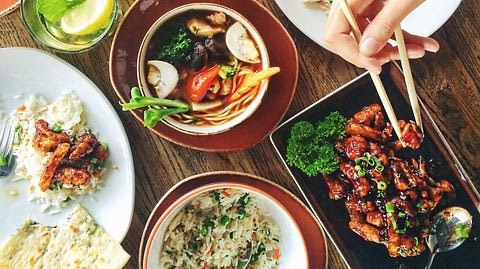
One of the habits we engage in daily that is strongly intertwined with cultural significance is 'dinner'.
In the United States, it is common to have dinner before sunset, while in Italy, the table is set after the sun has completely set.
In Spain, meals may not start until after 9 or 10 PM.
For some, dinner signifies the end of the day, while for others, it may mark the beginning of a small gathering with friends.
So, let's set aside cultural meanings for a moment and consider it from a scientific perspective.
"When is the best time to eat dinner for health?" This question seems simple but encompasses quite complex factors.
Dr. Valter Longo, a global aging researcher, emphasizes that "you should finish eating at least 3 hours before going to bed."
The reason is that our bodies function optimally according to the circadian rhythm, which follows the day and night cycle.
If you eat late, your body perceives that it is still 'active', which can degrade sleep quality and lead to inefficient metabolism.
For example, if your bedtime is midnight, you should finish eating by 9 PM.
This is not just a tip for better sleep. Our bodies metabolize food differently when we are eating compared to when we are fasting.
After a meal, carbohydrates are used as an energy source, but after a period of fasting, our bodies enter a state of 'fat oxidation', where fat is converted into energy.
Dr. Adam Collins from the University of Surrey refers to this as "time-restricted eating."
This is a form of intermittent fasting that limits eating to within 12 hours during the day, thereby increasing the duration of nighttime fasting.
This method has been reported to have positive health effects in various aspects, including weight management, improved insulin sensitivity, and enhanced fat metabolism.
So, is it better to eat breakfast late or to have an early dinner? Dr. Collins states, "There is much evidence that concentrating calories earlier in the day is more beneficial for metabolic health."
The morning is when the body is most actively preparing for digestion and metabolism, so a meal pattern that includes sufficient nutrition at breakfast and lunch, with a light dinner, is beneficial for health.
Meanwhile, Dr. Longo observed that people who live long lives commonly prefer 'light dinners'.
They tend to maintain a fasting state for over 12 hours after dinner, never skip breakfast, and generally show a trend of decreasing meal size as the day progresses.
"Eat breakfast like a king, lunch like a prince, and dinner like a pauper."
This advice holds true for a reason. Ultimately, the answer to the question of 'when is the best time to eat dinner' depends on 'when do I sleep' and 'what does my body need right now'.
Finishing meals early according to your body rhythm and concentrating energy during the day can be a wise choice.
Do you plan to have dinner tonight, perhaps not too late?
Light, early, and relaxed. That is the formula for dinner for both body and mind.







 Khan Film Blog Production |
 dermoon |
 hoosierdaddy |
 sun walker |
 Let's Be Like a Salt-like City Person |
 Enjoyable American Life Diary |
 Utah, the Most Livable State |
 morvex37 |

 Korean Mom |
  My NYC |
  moo moo |
  Mr Oh |
  forevergee |
  festival |
  manchester |
  constant |
  Leapfrog Move |
  vibranto |
  Tora Tora |
  yellowbutter |
  Dolly |
  US Embassy |
  NYC saladbar |
  Finding Superfoods |
  lightyear |
  song bang |
  vexomo |
  Indiana Jones |