

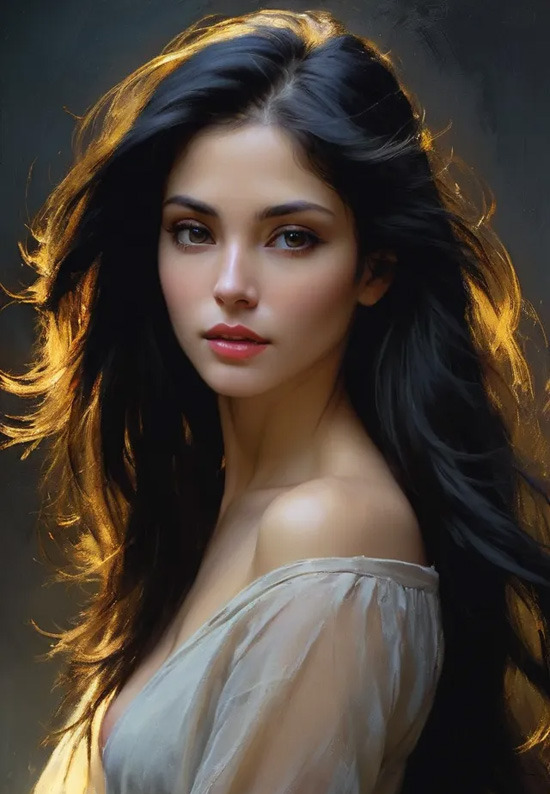
Imagine the studios of old painters. They would wait for the right natural light, pose their models in the same position, and pick up their brushes.
With even a slight change in light, the atmosphere would shift, so the time they could work in a day was only a few hours.
Some works took months, or even years, to complete. Within that time, the painter's observation, patience, and the model's struggles were all captured.
But now, AI can generate a face that doesn't even exist, and it does so in a matter of seconds, creating a face that looks familiar and natural.
It looks like a photograph, but it isn't; it resembles a model, but it's not a real person.
Some people see this situation and declare, "Art is dead."
The Secret of the "Familiar-Looking" Face
When you see a face generated by AI, it evokes a strange feeling.
"I feel like I've seen this before?" This sensation is not a coincidence.
AI learns from millions of human face data, combining the most harmonious and generally attractive features.
In simple terms, it calculates the "ideal proportions" that humans have sought for thousands of years through data.
Every time this topic comes up, one side says, "Now anyone can be an artist," while the other side insists, "That's not art."
But the real issue isn't there. Nowadays, social media is flooded with faces created by AI.
Porcelain skin, perfect proportions, combinations that are hard to find in reality.
The problem is that when you see this every day, your brain starts to mistake it for the default standard.
In reality, AI images are the result of selecting only the most attractive features from billions of face data. It's like presenting faces that cannot exist in reality every day. As our standards keep rising, the chances of meeting such people in real life are zero. If there's no sense of dissonance, that's even stranger.
This is an extension of filter culture. If selfie filters have made us accustomed to the "corrected me," AI has set the standard to "non-existent perfection." Technology has advanced, but the mental state of humans consuming it remains the same. In the end, comparisons increase while satisfaction decreases.
And one interesting thing is that as AI-generated faces become too perfect, the human-like imperfections are becoming more special. Slight asymmetry, small flaws, natural expressions. These things give a sense of "realness."
It's similar to how vinyl records have regained popularity. As digital audio becomes perfect, people seek the warm noise of analog. The closer technology gets to perfection, the more humanity and familiarity we feel in imperfections than before. This is a very intriguing paradox.
To those who say, "Art is dead," I have just one thing to say. Art has never died.
Every time a tool changes, there have been rumors of its death. And each time, it has returned in a new form.
What we should truly be wary of is not the death of art, but the human instinct to fit ourselves into the standards created by AI.
Tools are just tools. How we consume them is ultimately up to us.






 novapixel |
 Peter Pan Pet |
 horse |
 Sunset Oregon |
 daisypat |
 Enjoyable American Life Diary |
 Utah, the Most Livable State |
 morvex37 |

 manchester |
  constant |
  Leapfrog Move |
  vibranto |
  Tora Tora |
  yellowbutter |
  Dolly |
  US Embassy |
  NYC saladbar |
  Finding Superfoods |
  lightyear |
  song bang |
  vexomo |
  Indiana Jones |
  meloncat |
  mortrix |
  Esther 1983 |
  fortbliss |
  Moscow Kim |