
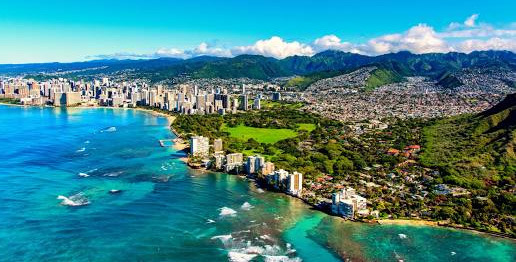
Honolulu is the capital and largest city of the Hawaiian Islands, serving as the center of Hawaiian history and culture.
The name Honolulu means "protected harbor" in Hawaiian, and due to its geographical location, it has developed into the center of the economy, politics, and culture of the Hawaiian Islands.
The history of Honolulu began about 1,500 years ago when Polynesian navigators migrated to the Hawaiian Islands. The Polynesians traveled across the Pacific in canoes and settled in Hawaii, establishing a self-sufficient lifestyle based on abundant natural resources and a mild climate. At that time, Honolulu was a place where local communities grew based on its rich natural harbor and fertile land.
In 1778, British explorer James Cook first introduced the Hawaiian Islands to Europe, marking the beginning of contact between the Western world and Hawaii. Subsequently, in 1794, British captain William Brown became the first Westerner to dock at Honolulu Harbor, establishing Honolulu as an important hub for Pacific trade.
In 1810, after King Kamehameha the Great unified the Hawaiian Islands, Honolulu grew into a major city of the Hawaiian Kingdom. Notably, in 1845, when the capital of the Hawaiian Kingdom moved from Lahaina to Honolulu, the city's political significance greatly increased.During this period, Honolulu developed as a center of international trade, with major trade items including whale oil, sugarcane, and pineapples. As the number of Western ships docking and commercial activities increased, the city's harbor and infrastructure expanded, and schools and churches were established by Western missionaries. The Iolani Palace, built during this time, is a magnificent structure of the Hawaiian Kingdom that still showcases the glory of that era today.
By the end of the 19th century, Hawaii was under economic and political pressure from Western powers. In 1893, Queen Liliʻuokalani, the last queen of the Hawaiian Kingdom, was forcibly deposed, leading to the kingdom's downfall.
Afterward, Hawaii became a protectorate of the United States and was annexed in 1898. Honolulu developed as the center of administration and economy in Hawaii, and its role as a major port and military base was also strengthened.
On December 7, 1941, the Japanese attack on Pearl Harbor occurred near Honolulu, which became the catalyst for the United States' entry into World War II. Pearl Harbor is an area adjacent to Honolulu and holds significant military and political meaning in the history of Hawaii and the United States.After this event, Honolulu established itself as a military and strategic center in the Pacific region, and the city's infrastructure expanded significantly during the war.
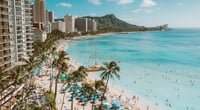
On August 21, 1959, Hawaii was officially elevated to the 50th state of the United States. Honolulu established its official status as the capital of Hawaii and subsequently grew into an international city alongside the development of the tourism industry.Today, Honolulu functions as the political, economic, and cultural center of Hawaii, attracting millions of tourists annually as a world-renowned tourist destination. Attractions such as Waikiki Beach, Iolani Palace, and Diamond Head showcase both the rich history and modern charm of Honolulu.
Honolulu is a multicultural city where Hawaiian native culture, Western culture, and Asian culture coexist harmoniously, establishing itself as a unique and global city.




 victoria 68 |
 Hawaii Tourist Information |

 TEX MEX STAR |
 Vacation on Hawaii |
  US Embassy |
  Korean Mom |
  My NYC |
  moo moo |
  Mr Oh |
  forevergee |
  festival |
  manchester |
  constant |
  Leapfrog Move |
  vibranto |
  Tora Tora |
  yellowbutter |
  Dolly |
  NYC saladbar |
  Finding Superfoods |
  lightyear |
  song bang |
  vexomo |
  Indiana Jones |