

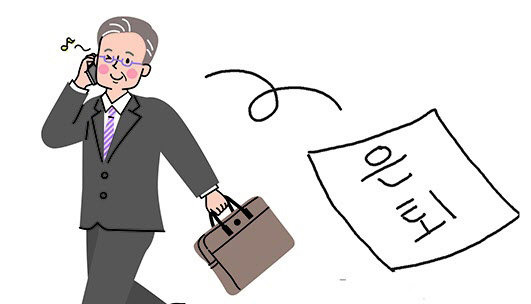
As a self-employed person in Denver, I often find myself wondering, "When is the right time to retire in America?"
Some people retire at 60 due to job regulations, while others retire at 63, and some continue working even at 72.
Growing up in Korea, I vaguely thought of retirement as around 60, and nowadays, around 65, but in America, it's not that simple.
News reports say the average retirement age is increasing, and looking around, as I mentioned earlier, many people work past 70. There isn't a single standard.
One commonly mentioned benchmark in the U.S. is when you start receiving Social Security benefits.
There's a point referred to as the 'full retirement age,' which varies by birth year, but currently, it's generally between 66 and 67. You can receive 100% of your benefits starting at this age. However, you can also opt for early retirement at 62, though the amount will be reduced. Conversely, if you delay until 70, you'll receive more. So, the concept of "retirement age" is already optional.
In Denver, the actual retirement timing is completely case-by-case. This is especially true for self-employed individuals. For someone like me who runs a business, the concept of "retirement" is vague. I work until I can't anymore. As long as I'm generating revenue and maintaining my health, I keep working. In fact, not working makes me feel more anxious. Unlike in Korea, where there's a fixed retirement age, here, it's up to the individual to decide when to stop.
Public employees and teachers have a different situation. They have a well-established pension system. For example, public school teachers are enrolled in state pension systems, and after a certain period of service, they receive relatively stable pensions. However, it's not like Korea, where you get a lifelong pension after a few years of service. Typically, you need to work for 20 to 30 years to receive a meaningful pension. Therefore, while some teachers retire in their mid-50s, many endure until their 60s to increase their pension amounts.
Police officers and firefighters tend to retire a bit earlier. This is a high-risk profession, so it's common for them to retire in their early 50s after 20 years of service.
However, they don't completely stop working; they often transition to other jobs. Many move into security or administrative roles. So, it's more accurate to view this as a "first career retirement." In Korea, police and military personnel also tend to retire relatively early, but in the U.S., the options afterward are much more diverse.
Military personnel are similar. After 20 years of service, they can receive a pension, so many retire in their early to mid-40s.
But that's not the end. They often enter the private sector or move into government-related jobs, starting a second career. This is the American structure. Instead of staying at one job for life, careers are divided into segments.
Comparing this to Korea, the differences are clear. Korea still has a strong concept of "retirement age." You must leave your job at a set age in companies or public institutions. The issue arises afterward. Since re-employment is not easy, retirement feels like a significant break in life. In contrast, in America, retirement is more of a transition than a break. The point at which one completely stops working is delayed, but the form of work changes.
That said, it's also difficult to say that the American system is necessarily better. Realistically, it's a structure where "you have to keep working." Considering medical expenses, living costs, and inflation, pensions alone are often insufficient. That's why news reports about "increasing numbers of seniors working after retirement" keep coming up. In many cases, it's more about necessity than choice.
In Denver, it's common to see people in their 70s working part-time. You can find them in cafes, grocery stores, and airports. At first, I thought, "What great passion!" but over time, my perspective changed. I realized this isn't just a matter of passion; it's a structural issue.
In conclusion, there is no "exact retirement age" in America. You can start at 62 and go up to 70, with many continuing to work beyond that. While public employees, teachers, police, and military personnel have their own standards, ultimately, it varies based on individual choices and circumstances. It's difficult to explain it with a single standard like in Korea.
So nowadays, rather than pondering retirement age, it seems more realistic to ask, "How can I work longer?"
This includes managing health, skills, and relationships. From my experience running a business in Denver, it seems that instead of preparing for when to retire, it's more about being ready to keep working for the sake of quality of life and health.





 zentar |
 seouljung |
 AliAluAlo Blog |
 excel |
 orvik90 |
 Your Curiosity Resolved |
 Jellia Angel |
 Jean Claude Bundang Blog |
 Nuchuhan Exploration BLOG |
 Mr. Largo |
  breezem |
  Omelet Rice for Strength |
  Vermont Capt |
  Softy |
  solid90 |
  waltz |
  Ohio Ohayoung Hello |
  parlon |
  Shoot Me |
  Michigan Enthusiast |
  festive |
  You Turn Me On |
  Supplemental Security Income (SSI) Information |
  Sams Market |
  ansdal |
  VVV 80 |
  BIODOCTOR NEWS |
  Gold Bar |
  Tamfa Fan |