

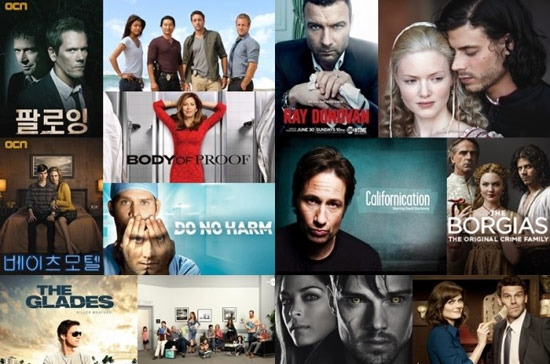
When people say they want to improve their English, most think of memorizing vocabulary, studying grammar, or attending speaking classes. However, watching American dramas reveals that what truly brings conversations to life is 'conversational sense' rather than English skills.
Even the same words can completely change the atmosphere depending on where they are inserted and the timing of their delivery. A single word can resolve awkwardness or encourage the other person to chat more naturally.
For example, when someone shares their daily life, throwing in short reactions like "Seriously?" or "No way"—common phrases heard in dramas—can keep the conversation flowing naturally, even if you can't form long sentences. Adding expression or intonation to that one phrase can create a 'conversational feeling' even with basic English.
Therefore, when watching dramas, it's much more helpful to observe not just the story but also the pauses between lines, how characters interrupt each other, and the rhythm of responding to jokes. Importantly, it's about 'trying to use what you've seen right away.' If you rephrase expressions you heard in a drama into your own words, they transform from memorized sentences into phrases you can actually use.
For instance, if a character says to a friend, "You gotta be kidding me," instead of just memorizing it, you should try to use it in real life, even if it feels forced. If a friend says something ridiculous, you can immediately respond with that expression. It's okay if it feels awkward; you need to practice using it to be able to use it in real conversations. Also, while many suggest shadowing by repeatedly watching specific scenes, a more effective method is to 'mimic the entire situation.' This means not just repeating the lines but also imitating the character's gestures, eye movements, and laughter in that moment.
Even if it feels a bit awkward, I think it's fine. In fact, such exaggeration helps you grasp the rhythm of English, and as tone and emotion connect, you build 'English that remembers the whole situation' rather than just words.
From this perspective, English ultimately revolves around 'the ability to listen to a situation and respond.' It's not that someone who speaks well is good at English; rather, it's someone who knows how to throw in the right words at the right moment that appears fluent in English.
However, while watching dramas, the swearing and slang used by characters can be so entertaining that you want to mimic them immediately. Especially expressions exchanged casually among friends seem light-hearted and are often used by real Americans, making them even more appealing. But using such expressions out of context can create a cold atmosphere or make the other person uncomfortable.
The reason swearing feels natural in dramas is that the characters have a high level of intimacy and the situations are portrayed as conflicts or comedies. Moreover, most of the dialogue is exaggerated, so in reality, it is used much more cautiously. For example, if you throw a swear word from a playful scene among friends at someone you just met, you will come off as rude, and using light slang with a boss will immediately label you as disrespectful.
In the U.S., the acceptability of swearing varies by class, generation, and relationship, so if a foreigner tries it, they might give the impression of asking, "Why are you saying this so strongly?" Ultimately, swearing or slang is not just about the words themselves but about 'when, to whom, and in what tone' it is used.
Therefore, while learning expressions from dramas is good, rather than blindly mimicking them, you should first read the context of when to use them, what the expressions and reactions are like, and the temperature of the situation. Remember that English skills start with tone, and the sense of tone is completed with caution.
So from today, think of watching dramas not as studying but as observing, and expressions not as memorizing but as 'experiments to use right away.' The conversational sense you build up will ultimately become your true English skills that enhance your conversations.
 BroPloti





 fortbliss |
 Folding Instructions |
 yentra |
 Cali M Law Group |
 quanta7 |
 Enjoyable American Life Diary |

 morvex37 |

 vibranto |
  Tora Tora |
  yellowbutter |
  Dolly |
  US Embassy |
  NYC saladbar |
  Finding Superfoods |
  lightyear |
  song bang |
  vexomo |
  Indiana Jones |
  meloncat |
  novapixel |
  mortrix |
  Esther 1983 |
  Moscow Kim |
  My Two Way |
  toastyfox |
  FLORIDA Acus |