
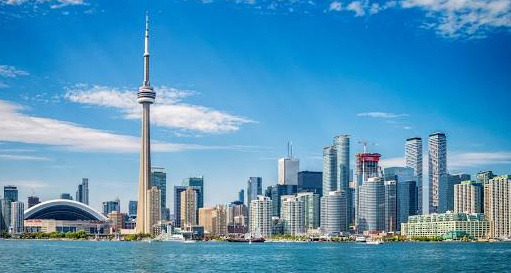
The City of Toronto is the capital of Ontario, Canada, and the largest city in Canada.
About 3 million people live in downtown Toronto, making it the most populous single city in Canada.
Including the Greater Toronto Area (GTA), the population increases to about 6.7 million, and the population of the surrounding satellite cities influenced by Toronto in the Golden Horseshoe region reaches approximately 9.76 million.
Thus, Toronto serves as a center of society, culture, and economy, where about a quarter of Canada's total population is concentrated.
Toronto is located in southern Ontario, on the northern shore of Lake Ontario, and has unique geographical characteristics. The features of this area are similar to those of Chicago in several ways, which can be found in its location adjacent to the Great Lakes and its urban structure.
Geographical Features of Toronto
- City by the lake: Downtown Toronto is adjacent to Lake Ontario to the south, similar to how Chicago is next to Lake Michigan.
- Due to this geographical layout, the city's expansion is only possible to the north and east/west, naturally increasing urban density.
- Flat terrain: Toronto consists of flat land with almost no hills or mountains, which has influenced its grid-like urban design. This is also one of the similarities with Chicago.
- Greenbelt restrictions: The outskirts of the city are bound by a greenbelt for environmental protection, limiting the available land for development. As a result, high-rise buildings are increasing around downtown.
Role and Importance of Toronto
Social center:
A multicultural city encompassing various ethnicities and cultures, with over 140 languages spoken and people from diverse backgrounds coexisting.Cultural center:
Home to world-class performance venues, museums, and art galleries, it is a beloved place for those who love culture and the arts. TIFF (Toronto International Film Festival) is considered one of the top three film festivals in the world, attracting film enthusiasts from around the globe every year.Economic center:
Toronto is Canada's financial hub, housing major banks and corporate headquarters. Notably, the Toronto Stock Exchange (TSX) is one of the largest stock exchanges in the world.
Housing Structure and Sprawl Phenomenon
- Single-family home-centered city:
About 62.3% of Toronto's residential area consists of single-family homes. This reflects a typical sprawl phenomenon commonly seen in North American cities. - Land use regulations:
Most major cities in Canada follow strict land use regulations that restrict the construction of single-family homes to specific areas.- In many areas, even the construction of 2-3 story multi-family homes is prohibited, resulting in a predominance of single-family homes with large yards.
- These regulations encourage the city to expand horizontally, often leading to inefficient use of land and resources.
Changes and Developments
In recent years, Toronto has shown movements to improve its single-family home-centered policies.
- High-density strategy:
Plans are underway to build more high-rise residential buildings in key urban areas to address housing shortages. - Regulatory relaxation:
In 2022, Ontario Premier Doug Ford announced plans to relax land use regulations to alleviate housing shortages. This is expected to facilitate the construction of more multi-family homes and apartments, contributing to increased residential density.
Future Prospects
Toronto is in a transitional phase, aiming to address the existing widespread sprawl and shift towards a high-density city. If housing shortages are resolved and various types of housing facilities are expanded, Toronto is likely to develop into a more livable city for a larger population.
The changes in the city are expected to have positive impacts from environmental, social, and economic perspectives, and it has the potential to become a global best practice, not just in Canada but worldwide.







 Darnignac |
 Delicious Food Finder |


 Belgray Miscellany |
 American Golf Course Travelogue |
  Tonky |
  viroma |
  cookie |
  Live and that's it |
  Alright Twain |
  eatontown blog |
  HAWAII Korean Church News |
  Amore |
  linex |
  Balancework |
  laro90 |
  MEDBIO American Doctor Blog |
  SWAT TEAM BLK |
  DREAM BIG |
  frostbite |
  330 Forever My Love |
  El Dorado |
  dralix58 |
  Gorama Round |
  Skydiving |