

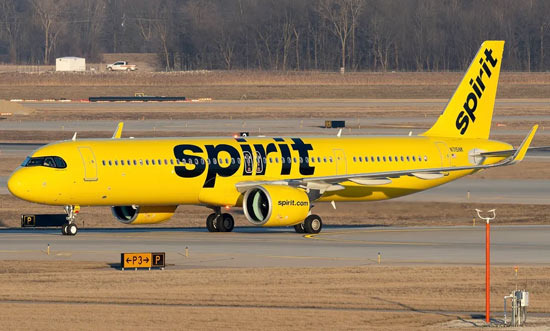
These days, Spirit Airlines is a name that frequently appears in news about the U.S. airline industry.
Reports of a significant drop in stock prices and analyses indicating poor financial conditions have led to speculation about whether the airline might go bankrupt. As one of the most prominent ultra-low-cost carriers in the U.S., it has garnered a lot of public interest.
I also tend to fly quite often in the U.S., and when I head to the East Coast, I usually use New York's LaGuardia Airport.
Among New York's airports, it is favored by many for its accessibility and proximity to the city. However, if you visit LaGuardia, you will often see yellow planes among the many airline flights, which are Spirit Airlines flights.
Spirit Airlines represents the ultra-low-cost carrier model known as ULCC in the U.S.
The base ticket prices are unbelievably low. Some routes are sold for around $60 or $70. However, most services require additional payment. Seat selection and carry-on luggage are both charged. Even a bottle of water costs extra.
First-time users might be a bit surprised.
Some people feel, "Is this really an airplane? It feels almost like a bus!" However, thanks to this system, many people have been able to fly without financial burden. It has been a practical choice, especially for students, young travelers, and those looking to save costs.
In fact, when you see people using Spirit at New York's LaGuardia Airport, the atmosphere among travelers feels a bit different. Many are dressed much more casually than those flying with major airlines. You can see people moving with just a backpack, and there are many young travelers heading out for weekend trips. It serves as a truly affordable means of transportation.
However, the airline industry environment has changed significantly in recent years. After the pandemic, travel demand has increased again, but the operational costs for airlines have also risen sharply. Fuel prices have gone up, and labor costs have increased. Costs like airport fees continue to rise as well. The ultra-low-cost airline model typically operates on thin margins, making it particularly vulnerable to these changes.
Competition has also intensified. Companies like Frontier are competing in a similar manner to ultra-low-cost carriers like Spirit.
Additionally, major airlines have started actively selling basic economy products. Price ranges that were previously only offered by ultra-low-cost carriers are now appearing in some major airlines as well.
Because of this, a few years ago, Spirit attempted to merge with another airline. Talks of a merger with JetBlue progressed significantly but ultimately fell through due to regulatory issues. Since then, analyses suggest that the company's situation has worsened.
That said, it is not likely to disappear immediately. The role of ultra-low-cost carriers in the U.S. airline market is quite important. These companies help prevent overall airfare from rising excessively. If such airlines were to completely vanish, travel costs would likely become much more expensive than they are now.
Moreover, in the airline industry, companies often survive through restructuring or mergers rather than shutting down immediately, even when facing difficulties.
This is because they possess assets like aircraft, routes, and airport slots. Therefore, many believe that Spirit is more likely to be restructured into a different form rather than completely disappearing.
When you see a Spirit plane at New York's LaGuardia Airport, it feels like a flight that provides travel opportunities for many people with lighter financial burdens, even if there is no in-flight service. Some are flying to meet family, while others are heading out for a weekend getaway.





 Good World Good Thoughts |
 celtics |
 candytip |
 Gold Bar |
 Pirate Ship Popcorn Maker |
 newyorker 101 |
 PPAP Pineapple Pen |
 NYC saladbar |
 Eating Gukbap and Working Hard Deer |
 Encyclopedia of New York and Surrounding Areas |
  vanilla |
  norvexi |
  Lunch and Dinner Mexican Taco |
  skykong |
  My Circle |
  novapixel |
  urban legend |
  coolriver |
  Good Neighborhood, Wealthy District Information |
  Ro Ro Car |
  Amber H |
  new sugar |
  Palm 1000 |
  loran |
  donutfield |
  Tennis City |
  sunny7 |
  Questions about firearms while living in America |
  Shoot Me |
  mochifox |