
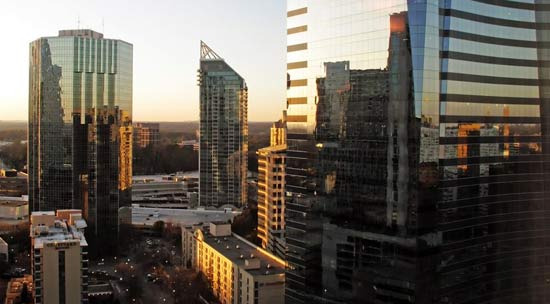
If you take a closer look at Atlanta, you can see that it has a quite unique economic structure among American cities.
It is different from the manufacturing-based rust belt cities, not a tech-centric Silicon Valley style, nor does it feel like a financial hub like New York. Atlanta is closer to a multi-nodal economy where various industries grow in a balanced manner. This allows it to be relatively resilient to economic fluctuations and shows a stable expansion trend in the long term.
First, the largest pillar is the logistics and transportation industry. No matter how digitalized the world becomes, logistics must function for the economy to move. Atlanta is home to one of the busiest airports in the world, Hartsfield-Jackson International Airport, and has a dense network of rail and truck transportation as a logistics hub in the southeastern United States. Its central location on the eastern part of the continent makes it easy to distribute goods to the north, east, and south, and it is close to global shipping companies like FedEx and UPS. The rapid establishment of Amazon logistics centers is a clear reason for this.
The second point is that it is a city of corporate headquarters. Well-known companies like Coca-Cola, Home Depot, UPS, Delta Air Lines, and CNN have their headquarters in Atlanta. Having a headquarters means more than just having a building; it signifies the presence of high-paying value-added personnel in areas such as high-end jobs, marketing, media, legal, IT, and research departments. This concentration of headquarters attracts other companies and fosters the growth of professional service industries such as consulting, advertising, tax, and legal services.
The third point is the film, video, and content industry. If Texas is known for oil, Atlanta is currently a hot city for content. Thanks to filming incentive policies, locations for Netflix, Disney, and Marvel movies are concentrated in Atlanta. Many superhero movies we see in theaters have been filmed in Georgia, with more than half of them being shot there. The ecosystem is forming with film studios, shooting sets, and post-production personnel, creating jobs and having a significant economic ripple effect on surrounding hospitality and food services. Just turning on your phone, you can easily spot the "Made in Georgia" logo.
The fourth point is the growth of fintech, cybersecurity, and IT. Atlanta can be said to be a tech city, not just Silicon Valley, as payment systems, digital finance, and security IT companies are rapidly growing. There is a strong engineering-based university called Georgia Tech, where graduates either start their own businesses or stay in the area, forming a talent pool. With the added advantage of lower rent and labor costs compared to the West, it creates favorable conditions for startups to establish themselves.
And we cannot overlook the power of diversity and immigrants. The high percentage of the Black middle class and the significant cultural influence of hip-hop are part of the city's identity. Both large corporations and startups actively engage with Black, Latin, and Asian communities, forming a flexible labor market. As the city continues to expand, there are many new homes in suburban areas, and the relatively reasonable housing costs compared to other major cities continue to drive population influx, which is a growth engine.
Of course, there are issues. Traffic congestion is well-known, and the rapid pace of urban expansion requires a balance with infrastructure, and there is also income disparity. However, the fact that various industries balance each other out is a much greater advantage than a disadvantage. It is not a structure where the collapse of a single industry shakes the entire city, but rather a form supported by multiple pillars.
In summary, Atlanta's economy is a multi-layered growth engine combining logistics, corporate headquarters, content, and IT. With low business costs, ample land, an influx of young populations, and a supply of university talent, it is highly likely to remain a central city in the southeastern United States for a long time to come.







 Cherokee Rose |
 Dingho and USA News |
 Korea Tiger News |
 moonshine 7 |
 DREAM BIG |
  frostbite |
  330 Forever My Love |
  El Dorado |
  dralix58 |
  Gorama Round |
  Skydiving |
  dreamport |
  Yellow Snowman |
  Toaster Pizza Magic Show |
  velvetnom |
  Anytime Journey |
  Mrs. Duluth |
  jaxter |
  Atlanta Mama |
  Baguette Blog |
  Tan Sol |
  US Embassy |
  Korean Mom |
  My NYC |