
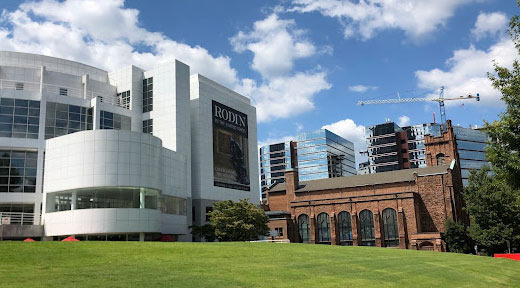
Atlanta has established itself as an important economic center (metropolitan powerhouse) both within the U.S. and globally, surpassing its status as the 'hub city of the South.'
To understand how Atlanta has grown over the past 30 years, we must first look at the foundation that allowed this city to thrive. Geographically, Atlanta is positioned as a hub in the southeastern U.S., making it advantageous for aviation and logistics. As a result, Hartsfield-Jackson International Airport has become a center for passenger and cargo transport not just in the U.S. but worldwide.
Additionally, Georgia and Metro Atlanta have strategically utilized incentives such as tax benefits and land/infrastructure provision to attract businesses. The steady influx of immigrants and migrants from the southern region has also contributed to a growing labor force and consumer market.
From the 1990s to the early 2000s, traditional manufacturing and distribution remained important, but there was a gradual shift towards service and logistics. Particularly in the 2000s, sectors such as transportation, logistics, aviation, media broadcasting (with CNN's headquarters here), telecommunications, and financial services began to drive the economy. The expansion of digital technology and communication infrastructure also led to growth in related service industries, boosting employment and economic scale.
Looking at the last 20 years, the industry has diversified even further. Between the mid-2000s and the 2010s, the increase in film and TV production attracted Georgia as a filming hub, leading to the establishment of many studios. Simultaneously, tech hubs formed around Atlanta, fostering the growth of IT and fintech companies, while demand for professional services such as accounting, law, and consulting rapidly increased. The healthcare and life sciences research sectors also became active, with hospitals, universities, and research institutions driving job creation and investment.
Population growth is another crucial point. The population of Metro Atlanta has steadily increased, thanks to immigrants and people relocating from other cities. Between 2020 and 2024, the population grew by about 4.7%, and this growth will continue to be a significant factor in regional development. As the population has increased, infrastructure has also expanded. The strengthening of roads, airports, logistics facilities, and rail connectivity has enhanced its role as a logistics hub. However, this process has also led to rising housing prices and gentrification, increasing the burden on existing residents.
Finally, looking at the economic scale, the GDP of the Atlanta metro area recently reached approximately $570.6 billion. Compared to the early 2000s, this figure has grown significantly, and considering inflation and productivity increases, the real growth rate is also quite high. Across industries, there is a noticeable shift from manufacturing to sectors like services, logistics, aviation, and media, with employment and wage levels rising on average.
However, growth alone has not resolved all issues. Income inequality, housing cost burdens, delays in infrastructure investment, traffic congestion, and environmental risks will require ongoing management.
The next decade will hinge on "sustainable growth" and "inclusive growth." For Atlanta to move to the next stage, policies that reduce the gap between high-income and low-skilled industries, improve transportation and housing infrastructure, enhance environmental resilience, and ensure that local residents can feel the benefits of economic growth are essential.








 Cherokee Rose |
 Dingho and USA News |
 moonshine 7 |

 Gimmi207 Blog |
  Atlanta Mama |
  Baguette Blog |
  US Embassy |
  Korean Mom |
  My NYC |
  moo moo |
  Mr Oh |
  forevergee |
  festival |
  manchester |
  constant |
  Leapfrog Move |
  vibranto |
  Tora Tora |
  yellowbutter |
  Dolly |
  NYC saladbar |
  Finding Superfoods |
  lightyear |
  song bang |