

Will the day come when protein design can cure incurable diseases?
Looking at the current scientific trends, the term "someday" is more accurately described as "soon."
Proteins are the true protagonists that handle all tasks within the body, but the problem has been that humans have only utilized proteins made by nature until now. However, with the advancement of protein design technology, it has become possible for humans to create proteins with functions not found in nature, and this is becoming the greatest hope for curing incurable diseases.
For example, we are currently designing proteins that can precisely target cancer cells that existing drugs cannot touch, proteins that can perform functions disrupted by genetic mutations, and proteins that neutralize toxic proteins. While we are not yet at the stage of solving all incurable diseases, the principles suggest that it will eventually be possible. Thanks to AI, the accuracy of protein structure prediction has improved significantly, speeding up the process and increasing the success rate of experiments. In conclusion, there is a sufficient possibility that the term incurable disease itself may disappear someday.
Simply put, protein design can be seen as the technology that allows humans to "custom-make" proteins.
Proteins are made up of 20 different amino acid pieces connected in a chain, and they do not just exist as long threads; they fold beautifully to perform their respective roles. Some unfold like a palm, some coil like springs, and others fold rigidly like square boxes. The shape of these folds determines the characteristics of the protein.
Proteins can be dirty, gentle, water-loving, or oil-loving... all of these properties depend on how they fold.
Thus, protein design involves predicting these folded structures in advance and rearranging the amino acid sequences to achieve the desired function. Creating something entirely new that does not exist in nature is called "de novo design," while slightly modifying an existing protein to give it new functions is called "redesign."
In the past, making such predictions was incredibly difficult, but nowadays, computers and AI have become smart enough to say, "This protein is likely to fold this way~" and provide accurate information. Scientists then use that sequence to create proteins in the lab and verify whether they fold correctly and function as intended.
Why is this technology important? Simply put, it allows for the infinite creation of proteins with new capabilities.
For example,
– Enzymes that reduce environmental pollution
– Proteins that specifically target cancer cells
– Therapeutic proteins with fewer side effects than existing drugs
– Super proteins that do not dissolve or break down even in factories
We have entered an era where all of these are possible thanks to protein design.
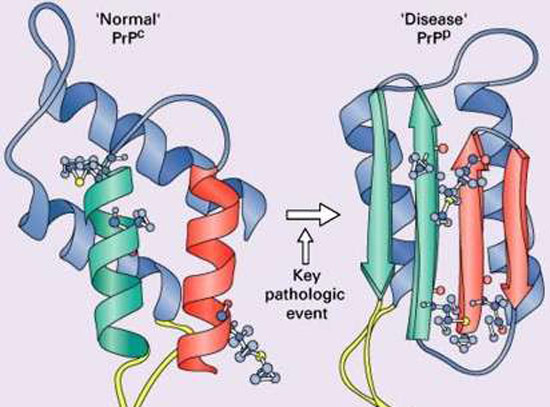
However, one crucial point to address is the entity known as prions.
What they are is misfolded proteins. The problem is that they are infectious. It does not just end with their own misfolding; they grab onto nearby normal proteins and say, "Hey, you fold like this too!" and ruin their shape.
They are a very unique existence that can ruin other proteins just by being misfolded, without having DNA or RNA like viruses or bacteria.
Especially when infected with the prion protein PrPsc, abnormal proteins accumulate in the brain, leading to memory loss, loss of balance, changes in cognitive abilities, and ultimately death. This results in a critical state where the brain gradually deteriorates. Bovine spongiform encephalopathy and Creutzfeldt–Jakob disease are diseases caused by this prion. The frightening thing is that prions do not die easily even at high temperatures and are resistant to disinfection.
Therefore, the most important aspect of protein design is to verify whether the proteins fold correctly and have good stability. If made incorrectly, problems like prions can arise.
Protein design is not just a simple scientific experiment; it is a technology that understands the basic elements of life and allows humans to develop them. In the future, there is a very high possibility that completely new proteins that do not exist in nature will emerge, transforming all fields including medicine, engineering, and the environment.
"We are entering an era where diseases like cancer, which are currently incurable, can be treated with proteins" is the right understanding.





 neroyo |
 nivex85 |
 Old English |
 nixxon |
 LIZ Legal Information Blog |
 squidogame |
 Margarine Daebimama |
 eatontown blog |
 Living in New Jersey blog |
 Google Idea |
  vibranto |
  Tora Tora |
  yellowbutter |
  Dolly |
  US Embassy |
  NYC saladbar |
  Finding Superfoods |
  lightyear |
  song bang |
  vexomo |
  Indiana Jones |
  meloncat |
  novapixel |
  mortrix |
  Esther 1983 |
  fortbliss |
  Moscow Kim |
  My Two Way |
  toastyfox |
  FLORIDA Acus |