

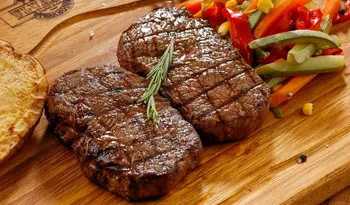
Tracing the roots of the word steak, we find it originates from the ancient Norse word "Steik."
Originally, it simply meant 'cooked dish,' but in culinary terms, it refers to meat cut against the grain into manageable sizes, then cooked over direct heat or in a pan to achieve a crispy exterior and juicy interior. Ultimately, the essence of steak lies more in its tender texture and ease of eating than in the cooking method. Thus, any meat that can be easily consumed with just a fork and knife can be considered steak.
Steak made its way to America when European immigrants arrived in the New World during the 17th and 18th centuries. Notably, British and Spanish immigrants brought their culinary traditions, and with America's vast lands and rich pastures, it was the perfect environment for raising cattle. Naturally, steak could develop significantly in this land.
With the opening of the American West in the 19th century, regions like Texas and Kansas became centers of cattle ranching, and as beef became abundant, steak established itself as a staple food. Many of us have seen scenes in Western films where cowboys grill thick cuts of meat by a campfire. This imagery connects American Western culture with steak.
Moreover, the development of railroads played a crucial role in making steak a national dish. Chicago was known as the 'city of slaughterhouses' and served as a hub for meat supply, allowing fresh beef to be shipped nationwide via rail. As a result, steak became a national dish enjoyed across the United States rather than being confined to specific regions.
With the popularization of steak, specialized steakhouses also emerged. Delmonico's in New York, which opened in 1837, is a representative high-end restaurant that showcased authentic steak and became a favorite among the upper class. From this point on, steak began to be recognized not just as a simple dish but as a formal food enjoyed during business meetings or special occasions.
Given America's vastness and distinct regional characteristics, various styles of steak have developed. New York style is characterized by a thin, crispy crust, making it fun to cut into large pieces, while Chicago style is thick, juicy, and has a subtle smoky flavor. Texas style, also known as cowboy steak, is large and bone-in, making a striking presence just by appearance. Each region adds its unique sauces and side dishes, creating even more diverse enjoyment.
Today, steak has established itself as a dish that can be enjoyed not only in fine dining restaurants but also at home. Just the thought of a sizzling steak grilled at a camping or barbecue gathering makes one's mouth water.
Ultimately, steak is not just a piece of meat; it embodies the history, culture, and lifestyle of America.







 Yellow Snowman |
 Moscow Kim |
 Seattle - Emerald City |
 self-evaluation |
 Sandiego Auntie |
 liquid asset |
 Amore |
 luido |

 Tennis City |
  Bushing Around Life |
  Active |
  Cherokee Rose |
  Kor. Master |
  Holey Moley |
  Conflite Teacher |
  Hodong Prince Over Flex |
  Mist inn |
  citrus pop |
  Onion Ring |
  phoenixia |
  viewtop |
  loverun |
  Kim Do Sun |
  SEVEN SEVEN |
  yentra |
  Make My Day |
  Victory 1988 |
  Tonky |
  viroma |