

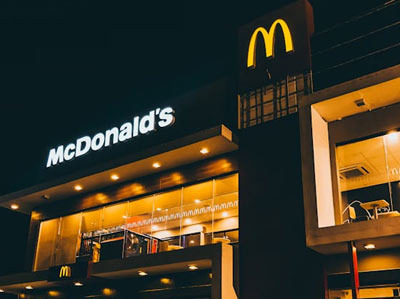
McDonald's exists as more than just a fast-food chain; its business model and operational methods are quite unique. Many people are curious about whether McDonald's branches in the U.S. are leased or company-owned, and I will explain this in detail.
McDonald's operates globally through a franchise system. In this franchise model, the McDonald's headquarters provides the brand, operational manuals, marketing support, and individual operators use these to run their stores. This model has laid the foundation for McDonald's rapid expansion, with over 90% of McDonald's branches worldwide operating as franchises.
The ownership structure of McDonald's branches can be broadly divided into company-owned and franchise-owned.
A. Franchise-Owned Branches
- Branch Owners: Most McDonald's branches are owned and operated by franchise owners (franchisers).
- Lease Agreements: Franchise owners lease the trademark and operational rights from McDonald's headquarters to run their stores. In this process, it is common to lease the store site.
- Rent and Royalties: Franchise owners pay rent based on the store's location and pay a percentage of sales as royalties to the headquarters.
- Operational Responsibility: Franchise owners are responsible for the daily operations of the store, employee management, inventory management, and must operate according to the headquarters' guidelines.
B. Company-Owned Branches
- Branch Owners: A small number of McDonald's branches are directly owned and operated by McDonald's headquarters.
- Ownership Type: These branches may be located on properties owned by the headquarters or may own their own sites.
- Operational Method: Company-owned branches operate under the direct management of the headquarters and follow strict standards to maintain the same quality and service as franchise-owned branches.
Ratio of Real Estate Ownership and Leasing
McDonald's global real estate strategy can be divided into two main categories:
- Real Estate Ownership: McDonald's directly owns some stores in key areas or strategically important locations. This is to maintain the core image of the brand and strengthen its influence in specific regions.
- Real Estate Leasing: Most stores are leased to franchise owners, which helps McDonald's reduce initial investment costs and expand rapidly.
Advantages and Disadvantages of McDonald's Franchise
Advantages
- Rapid Expansion: The franchise model allows for quick expansion of stores worldwide.
- Localized Operations: Each franchise owner can tailor operations to the local market, providing services that cater to diverse cultures and tastes.
- Risk Diversification: The risks of store operations are shared between the headquarters and franchise owners.
Disadvantages
- Difficulty in Maintaining Consistency: Different operational methods among franchise owners can make it challenging to maintain brand consistency.
- Limits of Control: The headquarters can exert some control over franchise owners' operations, but complete management may be difficult.
- Dependency on Royalties: The headquarters receives royalties from franchise owners, so poor sales can impact profits.
Number of McDonald's Branches in the U.S.
- Total Branches: There are estimated to be over 14,000 McDonald's branches in the U.S.
- Franchise Ratio: Over 90% of branches are operated by franchise owners.
- Directly Owned Branches: About 10% of branches are directly owned and operated by McDonald's headquarters.
The states where McDonald's franchise ownership is active in the U.S. include:
- California: With a high population density and large economy, many franchise owners exist.
- Texas: Due to its vast territory and diverse markets, there are many McDonald's branches.
- Florida: The distribution of McDonald's branches is high due to tourism and population growth.
- New York: Many franchise-owned branches operate in urban areas.
- Illinois: There are many McDonald's branches centered around Chicago.
Economic Impact
- Job Creation: McDonald's creates hundreds of thousands of jobs in the U.S., especially in franchise-owned branches.
- Local Economic Activation: McDonald's branches contribute to the activation of local business districts and positively impact surrounding shops and service industries.
- Real Estate Market: McDonald's real estate leasing plays a significant role in the local real estate market and increases demand for commercial real estate.
Future Outlook
- Digitalization and Automation: McDonald's is enhancing operational efficiency by introducing order automation systems, kiosks, and mobile apps. This is expected to positively impact franchise owners as well.
- Sustainability: With increasing interest in environmentally friendly operations and sustainable agriculture and material use, McDonald's is strengthening policies and strategies to align with this.
- Global Expansion: Based on its success in the U.S., McDonald's plans to expand into more diverse markets, and global growth through the franchise model will continue.
The ownership structure of McDonald's branches is centered around the franchise model, with most branches leased to franchise owners for operation. This provides McDonald's with a foundation for rapid global expansion and adaptation to various markets. The combination of franchise ownership and leasing plays a crucial role in McDonald's achieving stable and sustainable growth.
Franchise owners utilize McDonald's brand power and support to operate their businesses, contributing to providing consumers with consistent quality and service. Meanwhile, McDonald's headquarters maintains the core image of the brand and maximizes economic impact through real estate ownership and directly operated branches.






 eatontown blog |
 Toaster Pizza Magic Show |
 US Embassy |
 fortbliss |
 Folding Instructions |
 dermoon |
 crystalo |
 lavender |
 Tonky |
  viroma |
  cookie |
  Live and that's it |
  Alright Twain |
  HAWAII Korean Church News |
  Amore |
  linex |
  Balancework |
  laro90 |
  MEDBIO American Doctor Blog |
  SWAT TEAM BLK |
  DREAM BIG |
  frostbite |
  330 Forever My Love |
  El Dorado |
  dralix58 |
  Gorama Round |
  Skydiving |