

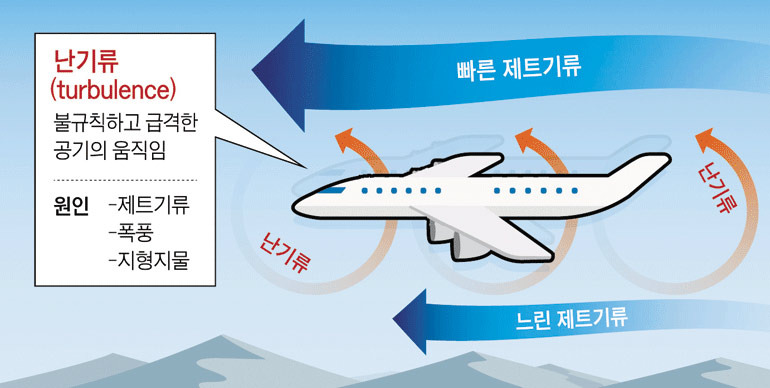
When you're on a plane and the aircraft starts shaking with the announcement to "fasten your seatbelts," that's the moment you're experiencing turbulence, or what we call turbulence in English.
Many people feel anxious, but in reality, turbulence is a very common and natural phenomenon during flights.
To explain turbulence simply, think of it as an invisible bumpy road in the sky.
Air flows like water, but this flow is not uniform; when it shakes up and down or creates whirlpools, the airplane is affected by it.
It's similar to how a car bounces when driving on an unpaved road.
There are several main types of turbulence.
The most common is thermal turbulence.
When the sun heats the ground unevenly during the day, warm air rises while cold air descends, causing instability in the air. This is why you often feel a slight shake when flying over desert areas like Nevada and New Mexico in the U.S.
The second type is turbulence that occurs around clouds and storms.
Inside large clouds like cumulonimbus, air moves very strongly up and down. Therefore, when pilots see clouds on the weather radar, they try to avoid them as much as possible. The turbulence in this case tends to be relatively strong.
The third type is the 'clear air turbulence' that many find fascinating.
Known as Clear Air Turbulence in English, it refers to the phenomenon where the sky is clear and there are no clouds, yet the plane suddenly shakes. This usually occurs at the boundaries of strong winds in the jet stream, which is high up in the atmosphere. Because it is not visible, it is difficult to predict, which is why pilots often emphasize the importance of wearing seatbelts.
Here's an important fact: turbulence rarely causes airplanes to crash.
Modern aircraft are designed with very strong structures that can withstand forces much greater than the shaking we feel. In fact, pilots describe turbulence as "a matter of discomfort, not a matter of safety."
So, is there a difference between domestic and international flights? Many people think that international flights fly higher and are therefore more stable. This is partly true and partly depends on the situation.
International flights, especially long-haul routes, usually fly at altitudes of about 35,000 to 41,000 feet.
At this altitude, the air is often relatively stable, resulting in less turbulence.
In contrast, domestic flights tend to have shorter flight times, leading to longer ascent and descent phases, and cruising altitudes are often lower, around 28,000 to 36,000 feet. This can create a perception of more frequent turbulence.
Another reason is flight duration. International flights can maintain stable conditions for longer periods during flights of over 10 hours, while domestic flights, which last only 2 to 3 hours, pass through more areas with changing atmospheric conditions.
However, an important point is that domestic flights do not always fly at low altitudes.
Depending on the type of aircraft, air traffic conditions, and weather, they can fly at sufficiently high altitudes. Conversely, international flights can also maintain lower altitudes due to wind or route issues.
Pilots always adjust altitudes or change routes to find smoother air layers. They also share information about turbulence reports from other aircraft that have passed through, indicating that "this altitude is bumpy." This is why altitude changes often occur during flights.
Ultimately, turbulence is a natural flow of the sky.
When the plane shakes, it's the sky that is rough, not the airplane that is in danger. And if you are seated with your seatbelt fastened, most turbulence can be thought of as just a simple "speed bump in the sky."







 candytip |
 Gold Bar |
 Pirate Ship Popcorn Maker |
 Montgomery Mom |
 Anjollinya Blog |
 Cherokee Rose |
 Dingho and USA News |
 Let's Be Like a Salt-like City Person |
 Gimmi207 Blog |
 moonshine 7 |
  vibranto |
  Tora Tora |
  yellowbutter |
  Dolly |
  US Embassy |
  NYC saladbar |
  Finding Superfoods |
  lightyear |
  song bang |
  vexomo |
  Indiana Jones |
  meloncat |
  novapixel |
  mortrix |
  Esther 1983 |
  fortbliss |
  Moscow Kim |
  My Two Way |
  toastyfox |
  FLORIDA Acus |