
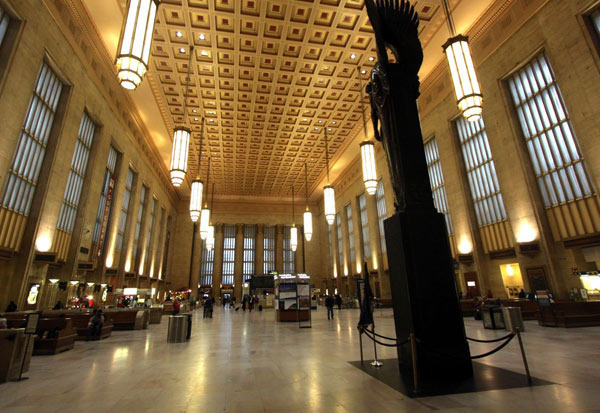
There is a place in Philadelphia where your footsteps are bound to stop at least once while taking the train. It is the William H. Gray III 30th Street Station, commonly referred to as "30th Street Station." However, if you take a closer look at this station, it becomes clear that it is not just a transportation hub for trains, but a massive Art Deco building that embodies the character of the entire city. While New York's Penn Station is bustling with activity and Boston's buildings appear quaint, this station showcases "the beauty of Philadelphia" with its strength and restrained ornamentation.
Upon entering the station, the first thing you notice is the overwhelming height of the ceiling and the massive columns. The marble-clad walls and golden decorative lines blend subtly, creating a weighty atmosphere without being overly flashy. This is a hallmark of the Art Deco style.
Art Deco is a design and architectural style that was popular in Europe and America from the 1920s to the 1940s, reflecting the confidence of the industrial age and the aesthetics of machine civilization. Instead of the ornate decorations of the past, it uses solid lines, symmetry, and geometric patterns to create a strong impression. Materials such as metal, marble, glass, and golden accents are frequently used, expressing the spirit of the era that "technology is beauty."
Buildings like the Chrysler Building in New York, Rockefeller Center, and Philadelphia's 30th Street Station are prime examples. They are decorative yet not excessive, modern yet substantial, and maintain a restrained elegance amidst their splendor. There is an atmosphere that can be felt through experience: "an aesthetic that shines not with flamboyance, but with confidence."
Additionally, the symbolism of the station's name adds to its significance. Originally known as 30th Street Station, it was later named after William H. Gray III, an African American politician and pastor. The name of a person who contributed to social justice and urban development is inscribed alongside this 'symbol of technology and industry.' Thus, the architectural beauty of the past and the meaning of the present coexist within a single building. Therefore, this station feels like a space that expresses the question, "What kind of city do you want to remember?"
The scenery around the station is also intriguing. 30th Street Station is positioned like an axis between cities, with educational and research institutions like Drexel University and the University of Pennsylvania on one side, and the urban skyline on the other. The landscape where the solid lines of the Art Deco building face modern glass structures perfectly illustrates the balance of "the old city vs. the newly changing city" that Philadelphia embodies.
Moreover, there are moments when this station, which may seem quiet, suddenly comes alive with activity. On days when conventions, sports events, and holiday seasons overlap, the long Art Deco central hall fills with a hum reminiscent of airplane engines. The thud of rolling suitcases, the hurried footsteps of shoes, and the voices of lost tourists all echo within the building, creating a rhythm. The massive structure swallows the sounds of people, creating a feeling that "the city is alive today."
Stepping outside, a grand marble staircase awaits. The skyline viewed while descending the stairs may not be flashy, but it appears honest, and the city breeze blowing from the Schuylkill River oddly complements the cold marble of the old station. Here, you feel like a traveler even without embarking on a journey, and moments of new discovery about the city arise even without getting lost.
Philadelphia's William H. Gray III 30th Street Station is a space where the boldness of Art Deco architecture coexists with the memories and present of the city.





 Northeastern |
 Nationally Certified Lightning Charcoal Review |
 American Grape Shine Muscat |
 sparkling |
 U.S. Weather Bureau News |
  Korean Mom |
  My NYC |
  moo moo |
  Mr Oh |
  forevergee |
  festival |
  manchester |
  constant |
  Leapfrog Move |
  vibranto |
  Tora Tora |
  yellowbutter |
  Dolly |
  US Embassy |
  NYC saladbar |
  Finding Superfoods |
  lightyear |
  song bang |
  vexomo |
  Indiana Jones |