
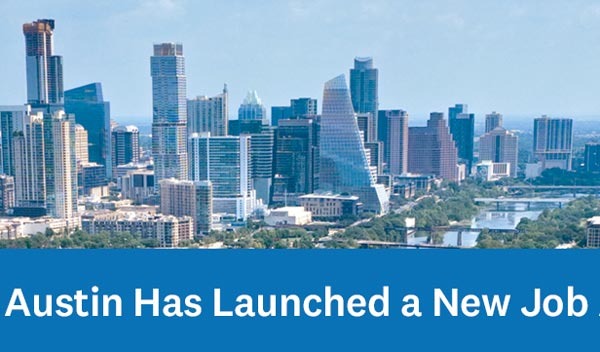
Austin's job market has been known as a "city where well-paying jobs gather" and has been growing rapidly, but recently, the pace has definitely slowed down.
After the explosive growth of tech jobs and the startup boom following the pandemic, it is now fitting to say that we are transitioning from a growth phase to a correction phase. There are still many opportunities, but the days when anyone could easily secure a good job are fading.
Just a few years ago, Austin earned the nickname "Silicon Hills" as companies leaving Silicon Valley flocked here. Global companies like Apple, Amazon, Google, and Oracle established campuses, and the atmosphere peaked when Tesla moved its headquarters. However, now this tech-centric job market is taking a breather. Some companies are freezing new hires or restructuring their workforce alongside reductions in remote work. Startup investments are not as active as before, making job competition among engineers and developers much fiercer.
Nevertheless, Austin's tech foundation remains solid. While there is restructuring centered around large corporations, fields like cloud computing, semiconductors, and artificial intelligence are steadily growing in the long term. For example, the semiconductor plant being built by Samsung in the Taylor area is set to restart with a goal of completion in 2026, and thousands of engineering jobs are expected to be created. Technical positions in semiconductor processes, equipment operation, and quality control are facing labor shortages. However, the formula that "anyone who enters tech will make money" no longer holds true.
The energy and renewable energy sectors are similar. Companies like Enphase, Tesla Energy, and ExxonMobil are expanding new technology projects near Austin, but this is also at the stage of investment adjustment, leading to a decrease in new hiring. Instead, these companies are selectively hiring skilled technical personnel. In simple terms, "while the number of hires has decreased, capable individuals are still in high demand."
Public institutions and administrative positions remain a stable job sector. Since Austin is the state capital, government-related departments, policy agencies, and university research institutes are not significantly affected by economic fluctuations. However, there is also limited movement in this area, so there are not many new opportunities. Research positions at universities like UT Austin require a high level of expertise, and while the healthcare sector is consistently looking for personnel, competition is fierce.
The healthcare sector continues to be a strong pillar of Austin's economy. Major healthcare institutions like Dell Medical School, St. David's HealthCare, and Ascension Seton exist, and the health tech industry, combined with IT technology, is steadily growing. However, the hospital workforce structure is already saturated, leading to a shift towards hiring experienced professionals rather than new hires. While the wage levels for healthcare jobs remain high, the barriers to entry have also increased.
The startup and creative industries are not as vibrant as they used to be. As the investment market has contracted, many early-stage companies are experiencing operational reductions or restructuring. However, thanks to large events like SXSW (South by Southwest), the creative professions and content industry still maintain some vitality. The advertising, video, and design sectors are small but have consistent demand.
Overall, the average salary in Austin remains relatively high compared to Texas. However, the issue is the cost of living. Housing prices have peaked and are in a correction phase but remain expensive, and rental costs are also significant. Once regarded as an ideal city of "high income + low cost," Austin has now become a city where "salaries are high but expenses are also high." As a result, many workers are choosing to move to suburbs like Cedar Park, Round Rock, and Leander and commute.
Ultimately, Austin can be described as a city "preparing for stability at the end of a growth phase." The rapid growth centered around technology has temporarily paused, and the market is undergoing realistic adjustments. In the next 1-2 years, companies will focus on workforce efficiency, but industries centered around semiconductors, energy, and AI are likely to grow again.
Therefore, it is correct to view the current Austin job market as "not that opportunities have disappeared, but that the standards have been raised."








 quanta7 |
 Living with a Consistent Heart |
 |
| 
 U.S. Weather Bureau News |
 History Repeats Itself |
  Atlanta Mama |
  Baguette Blog |
  US Embassy |
  Korean Mom |
  My NYC |
  moo moo |
  Mr Oh |
  forevergee |
  festival |
  manchester |
  constant |
  Leapfrog Move |
  vibranto |
  Tora Tora |
  yellowbutter |
  Dolly |
  NYC saladbar |
  Finding Superfoods |
  lightyear |
  song bang |