
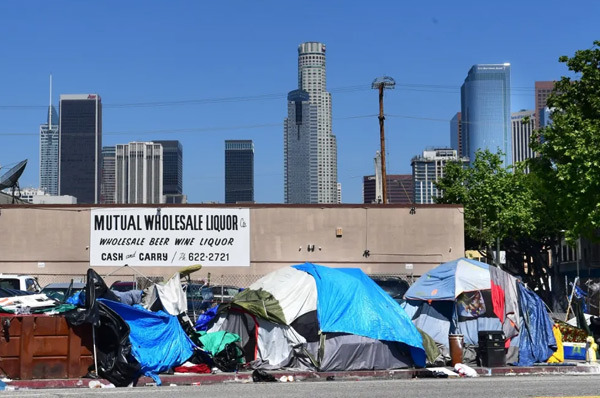
When I moved to Los Angeles 20 years ago, the homeless issue was concentrated in the downtown area known as 'Skid Row.' Unless you intentionally went there, you rarely saw homeless tents.
However, now it has become difficult to pass by without seeing homeless encampments even in Venice Beach, Hollywood, Koreatown, and even near West LA or Santa Monica.
What caused this change?
The biggest reason is the 'explosion of housing prices and rents.' Since 2010, the real estate market in LA has risen at the fastest rate in the entire United States. Demand is overflowing, but supply has hardly increased. As mentioned earlier, it is extremely difficult to build new homes. Moreover, as rents have also risen, it has become unaffordable not only for the middle class but also for low-income individuals. A one-bedroom apartment that used to cost $1,200 a month now exceeds $2,500, meaning that even a slight interruption in income can lead to homelessness.
The second reason is mental health and drug issues. The city of LA has long reduced facilities for the mentally ill. Since the 1980s and 90s, the state government has promoted a 'deinstitutionalization policy,' leading many patients to leave hospitals. However, the local community systems to support them have not been properly established. As a result, those who were not protected ended up on the streets. In recent years, the spread of powerful drugs like fentanyl has created a vicious cycle of addiction and homelessness.
The third reason is 'policy failure.' The city and state governments spend billions of dollars each year to solve the homeless issue. For example, through tax programs like Measure H or HHH, they promised to build thousands of units of low-income housing, but the actual completed housing fell short of half the target. The building permit process is complicated, construction costs have skyrocketed, and political interests are entangled. Meanwhile, the homeless population is increasing by thousands each year. Reports indicate that as of 2024, the total homeless population in LA County has exceeded 70,000.
Another reason is the pandemic. During COVID, many people lost their jobs and could not pay their mortgages or rents. The government temporarily prevented evictions, but as soon as the support ended, many were evicted due to overdue rent. They all came out onto the streets at once, leading to the tent cities we see today.
Finally, the climate and structure of LA also play a role. The warm weather and mild environment near the ocean make it easier for homeless individuals to survive compared to other cities. Unlike New York, where there is a risk of freezing to death in winter, many people naturally move to LA from other regions. Additionally, LA has a large area with many vacant lots and roadside spaces in the suburbs, making it easy to set up tents. These conditions have contributed to the spread of the homeless population.
Ultimately, the current situation is not simply about "the increase in homelessness" but rather a result of the city's structure, policies, and economic environment working together. Rising housing costs, lack of mental health support, drug proliferation, slow administration, and climate conditions are intertwined. While it used to be concentrated in a specific area like Skid Row, it is no longer just a problem of 'somewhere.' It has become a reality for the entire city.
Now, the streets of LA seem to reflect all of our lives. The tents visible on the commute, people sleeping under the highways, and elderly individuals pushing shopping carts. This is not just a matter of urban aesthetics. It is also a signal that the housing structure of a city has reached its limits.
The reason the problem that started in Skid Row has spread throughout the city is ultimately not just the issue of those without homes, but rather the result created by a 'city where homes are too expensive.'




 Weekend Movie Blog |
 Beauty, Health, Lifestyle Blog |
 coloradoman |
 Superman Cat Blog |
 Noodle Noodle |
  Tonky |
  viroma |
  cookie |
  Live and that's it |
  Alright Twain |
  eatontown blog |
  HAWAII Korean Church News |
  Amore |
  linex |
  Balancework |
  laro90 |
  MEDBIO American Doctor Blog |
  SWAT TEAM BLK |
  DREAM BIG |
  frostbite |
  330 Forever My Love |
  El Dorado |
  dralix58 |
  Gorama Round |
  Skydiving |