

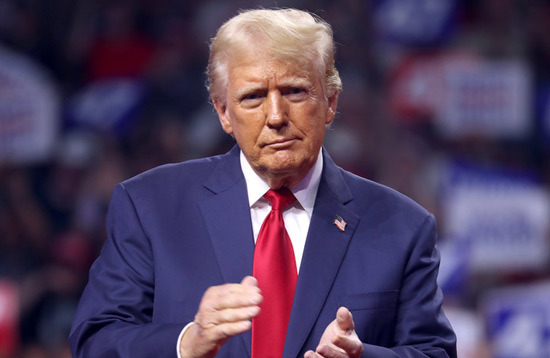
President Trump is engaged in a high-stakes battle at the Supreme Court over 'tariffs'.
This time, he is directly pressuring the Supreme Court regarding the 'tariff' issue.
Ahead of the oral arguments scheduled for November 5, he stated, "This trial is one of the most important events in American history."
"If we lose, the U.S. economy will fall into great chaos," he said.
He argues that based on the International Emergency Economic Powers Act (IEEPA) enacted in 1977, he can declare a national emergency and impose significant tariffs on imports by his authority.
However, the legal issue at stake is whether this law allows the president to unilaterally decide on such a heavy economic policy as 'imposing tariffs'.
Lower courts have ruled, "No, unless Congress clearly permits it, imposing tariffs solely by presidential authority exceeds the law." In fact, the revenue collected from tariffs amounts to billions of dollars, and if invalidated, there is a possibility of refunds, raising significant economic and political repercussions.
Thus, the Supreme Court has decided to make a final ruling on this matter, which is important as it could redefine presidential powers and trade policy frameworks in the future.
Given this situation, President Trump speaks as if the fate of the country hinges on the Supreme Court's ruling.
In a Fox News interview, he emphasized, "If we win this tariff lawsuit, America will continue to prosper, and if we lose, we will suffer for years." Just this statement reflects Trump's characteristic style.
Of course, this is not the first time a president has attempted to exert influence over the Supreme Court. In 2012, former President Barack Obama criticized the court for attempting to invalidate Obamacare, calling it "unprecedented," which sparked controversy. Ultimately, the Supreme Court barely recognized Obamacare as constitutional.
However, Trump has almost always appeared in court for cases he is involved in, including directly attending the 'hush money' case in New York. Last year, he even requested to attend the Supreme Court oral arguments, but the judge denied his request.
This Supreme Court case is about determining whether Trump had the unilateral authority to impose tariffs under the International Emergency Economic Powers Act. Currently, the Supreme Court consists of six conservatives, including three appointed by Trump, and three liberals, but experts say this case is not just a simple partisan battle but a nuanced issue regarding the scope of presidential powers, making it difficult to predict the outcome.
Throughout this year, Trump has claimed, "Thanks to tariffs, the country's finances have strengthened." According to the Treasury Department, tariff revenues have exceeded $174 billion this year alone. However, Treasury Secretary Scott Vought stated, "If the government loses in the Supreme Court, more than half of that will have to be refunded."
He continues to send messages on the social media platform Truth Social, stating, "If tariffs are invalidated, the country will collapse."
On November 5, every word he utters at the Supreme Court is sure to have a significant impact on American politics.







 Weekend Movie Blog |
 Beauty, Health, Lifestyle Blog |
 coloradoman |
 Superman Cat Blog |
 novapixel |
  Tonky |
  viroma |
  cookie |
  Live and that's it |
  Alright Twain |
  eatontown blog |
  HAWAII Korean Church News |
  Amore |
  linex |
  Balancework |
  laro90 |
  MEDBIO American Doctor Blog |
  SWAT TEAM BLK |
  DREAM BIG |
  frostbite |
  330 Forever My Love |
  El Dorado |
  dralix58 |
  Gorama Round |
  Skydiving |