
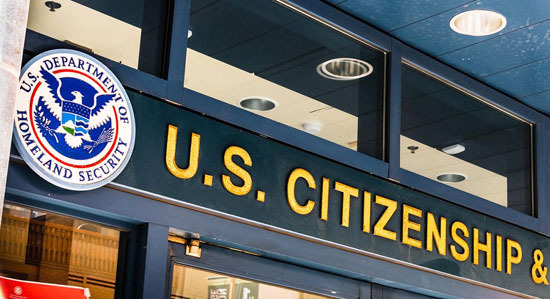
The U.S. immigration system operates with various agencies each taking on specific roles, among which USCIS (United States Citizenship and Immigration Services) and ICE (Immigration and Customs Enforcement) are closely connected.
On the surface, USCIS appears to handle legal immigration while ICE is responsible for enforcing against illegal immigration, but in practice, the two agencies often share information and conduct joint investigations. The reason is simple: immigration fraud, sham marriages, false identity applications, illegal employment, and crimes exploiting identity straddle the line between administration and investigation.
USCIS is the agency that manages information for all foreigners applying for legal residency, citizenship, and visa extensions or changes. All immigration documents, such as work visas (H-1B), student visas (F-1), green cards, and citizenship applications (N-400), are submitted and reviewed through USCIS. If suspicious cases arise, such as questionable relationships in marriage-based green card applications, multiple applicants registered at the same address, or non-existent jobs on paper, USCIS does not handle these alone but refers the information to HSI (Homeland Security Investigations), the investigative division of ICE.
HSI is the most powerful investigative organization within ICE, responsible for actual field investigations and undercover operations. HSI agents may visit residences based on cases flagged by USCIS or conduct interviews with acquaintances to verify the authenticity of a marriage. In sham marriage investigations, they may conduct interviews posing as newlyweds or meticulously verify the authenticity of wedding photos, shared financial accounts, and living patterns, which USCIS cannot do alone, making ICE's involvement essential.
Additionally, cooperation between the two agencies is crucial in cases of illegal employment or false employment sponsorship. If a foreign national applies for a visa based on a fraudulent employment contract, USCIS has the employer's details, while ICE investigates actual work status and wage payment through field investigations. If an employer illegally hires multiple foreigners in the same manner, ICE may view this as organized immigration fraud and escalate it to a criminal investigation. This type of cooperation serves a structural role in maintaining the integrity of the immigration system beyond just individual case enforcement.
Another important aspect is SEVIS (Student and Exchange Visitor Information System). This system tracks the visa status and school enrollment information of international students, which is operated by ICE but linked to the legal residency data managed by USCIS. If a student drops out or engages in illegal employment, the school reports this through SEVIS, and ICE initiates an investigation based on that information. During this process, USCIS's visa status records are also reviewed to determine whether the individual maintains their residency status.
Ultimately, the relationship between USCIS and ICE can be seen as a 'two-track' system of administration and investigation. While USCIS identifies 'who is suspicious' through documented data, ICE's role is to 'verify and enforce' those facts in the field. One side protects the door of legality and documentation, while the other catches those who misuse that door.
This collaborative framework enhances the efficiency of the U.S. immigration system while serving as a key pillar in preventing illegal immigration and fraud. However, human rights organizations criticize that such cooperation sometimes treats legal residents as potential criminals. The transfer of sensitive personal information collected by USCIS to ICE is also pointed out as a problem that fosters distrust among immigrants towards government agencies.
Nevertheless, the collaboration between the two agencies is expected to continue to strengthen. Especially with the introduction of AI-based data analysis and biometric technology, the system linking USCIS's administrative data with ICE's investigative data in real-time is anticipated to expand.








 Weekend Movie Blog |
 Beauty, Health, Lifestyle Blog |
 coloradoman |
 Superman Cat Blog |
 novapixel |
  Anytime Journey |
  Mrs. Duluth |
  jaxter |
  Atlanta Mama |
  Baguette Blog |
  US Embassy |
  Korean Mom |
  My NYC |
  moo moo |
  Mr Oh |
  forevergee |
  festival |
  manchester |
  constant |
  Leapfrog Move |
  vibranto |
  Tora Tora |
  yellowbutter |
  Dolly |
  NYC saladbar |