

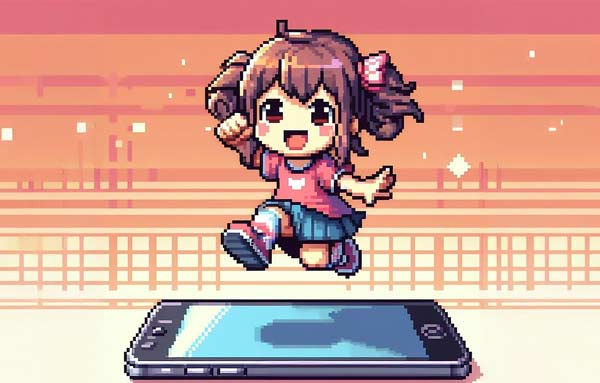
These days, games have such great graphics. Light reflections are depicted almost realistically, and you can see the pores on the characters' faces.
Yet, strangely, somewhere within that splendor, there seems to be a sense of emptiness. Perhaps that's why I sometimes long for the 8-bit feeling. A small pixel character bouncing and jumping on one side of the screen, and the days when we could only use a few colors to save space. The striking dots, unclear sprites, and graphics that demanded imagination instead of detail. Back then, that was all we had, but looking back now, it has its own 'flavor.'
Sitting crouched in front of the TV, inserting the cartridge, and blowing into it if it didn't turn on was a ritual that is now a memory. An era when we saved the world with just two buttons. The instructions were simple, and what needed to be done was clear. A was for jump, B was for attack. Unlike today, where tutorials can take an hour, we could jump right into the game.
The essence of the 8-bit feeling was pixels and limitations. To express the protagonist's emotions with just a few small squares, the designer's challenges must have been greater. With just two dots for eyes and a line for a mouth, we laughed and cried. The technical shortcomings pushed creativity further, and players filled the empty spaces with their imagination. In the process of Mario rescuing Princess Peach, what we saw was a simple life system and dot characters, but within that, there was adventure. Even without expanding the screen or having high resolution, we could get fully immersed.
And then there was the music. It accounted for half of the true 8-bit feeling. There were no grand orchestras. Instead, there were rough FM synth sounds, beeping sound chips, and melodies forced out of 3-4 tracks. Yet, strangely, the addiction was even stronger. Just hearing a single phrase like 'doo doo doo' brings back the smell of the floor from when I was ten.
Listening now, it's just a repetition of simple notes, but that simplicity sticks in the mind. The sound was so empty that we layered an orchestra in our imagination, and with a minimal screen, the world was filled in our hearts. Perhaps the power of the 8-bit feeling lies not in the games themselves but in how the players completed them.
The games of that time were also difficult. Without a save function, if you died once, you had to start over. There were no save slots, checkpoints, or difficulty adjustments like today. Seeing the ending was a symbol of patience and passion, and there were times when we gathered at a friend's house to take turns challenging the game. We laughed even after failing, and cheered when we succeeded. Like a 50 won game at the arcade, it was a short and intense enjoyment.
So, the resurgence of the 8-bit feeling is not just a simple retro trend; it may be a deeper emotion than we think. As technology advances, people long for simplicity. They prefer roughness over flashy decorations, and the emptiness of sound over rich audio. Pixels were not incomplete; they were a 'space' that users could complete with their imagination. In that clumsiness, where we stared at the TV screen so closely that our eyes hurt, we were truly playing.
Sometimes, when I play 8-bit MIDI covers through headphones at night, the world slows down a bit. The peace of an era when all you needed were two buttons, without busyness, battles, or competition, seeps in.
The graphics were rough, and the music was scratchy, but that's what made that era so warm. No matter how much modern games have advanced, the reason they can't fully replicate that feeling is probably because the 'joy of even discomfort' was present back then.
Anyone who remembers a pixel or a tone of sound will know. That time was good because it was lacking.






 Weekend Movie Blog |
 Beauty, Health, Lifestyle Blog |
 coloradoman |
 Superman Cat Blog |
 novapixel |
  DREAM BIG |
  frostbite |
  330 Forever My Love |
  El Dorado |
  dralix58 |
  Gorama Round |
  Skydiving |
  dreamport |
  Yellow Snowman |
  Toaster Pizza Magic Show |
  velvetnom |
  Anytime Journey |
  Mrs. Duluth |
  jaxter |
  Atlanta Mama |
  Baguette Blog |
  Tan Sol |
  US Embassy |
  Korean Mom |
  My NYC |