

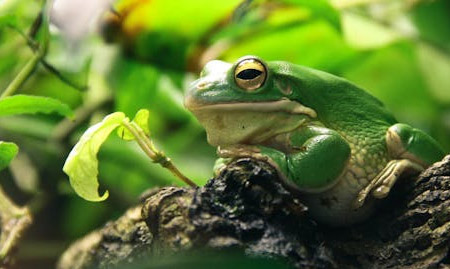
The United States has such a vast land area that its climates vary greatly, resulting in over 100 species of frogs.
Among them, the most commonly encountered is the 'American Bullfrog.'
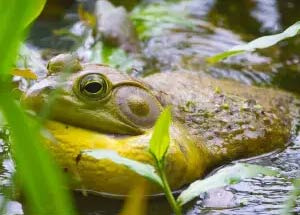
It is quite large and has a deep "broom" call at night, making it hard to forget once you hear it.
In contrast, the 'Wood Frog' living in the Alaskan forests freezes solid in winter and awakens again in spring, making it a survival champion.
And on the western coastal forests, the 'Pacific Chorus Frog' with its attractive green stripes around its eyes sings a high-pitched chorus on the fallen leaves.
In the southeastern sandy areas, there is also the 'Spadefoot Toad,' which only appears on rainy nights.
Korea has relatively fewer species, with about 13, but they are quite distinctive.
The 'Korean Brown Frog,' commonly seen in rice paddies, is about 4 centimeters long, and during the breeding season, its brown patterns darken, blending perfectly with the rice field background.
The 'Suwon Frog,' which lives only in the western coastal plains of Gyeonggi and Chungcheong, depends on rice paddy areas for survival and is sensitive to changes in agricultural land.
The 'Oriental Fire-bellied Toad,' with bright red patterns on its belly, shows its belly when threatened, boasting cutely, "I am poisonous!"
Here's a quick comparison of frogs from the United States and Korea.
-
Species Diversity
-
United States: With a wide range of climates from tropical to tundra, there is a broad spectrum of large and extreme adaptation species.
-
Korea: Within the limits of a temperate climate, medium and small endemic species are predominant.
-
-
Habitat Style
-
United States: Species evolved to fit various environments such as deserts, grasslands, and wetlands are widely distributed.
-
Korea: Thanks to the rice farming culture, many species move between artificial wetlands like rice paddies and reservoirs and forests.
-
-
Survival Strategies
-
United States: There are freeze-tolerant species that hibernate in an ice state, like the Wood Frog.
-
Korea: They hide underground or underwater in winter, but there are no species that can withstand ice.
-
-
Relationship with Humans
-
United States: Bullfrogs are used for food and fishing bait, and children enjoy frog-raising experiences in the summer.
-
Korea: The calls of the Green Frog are often used to predict the rainy season and frequently appear in proverbs, making them culturally familiar.
-
In summary, the United States is a 'paradise of diversity', while Korea is a 'refuge of endemic species.'
Next time you hear a croaking sound while walking by the water, it might be fun to wonder, "Where is this one from?"





 Baguette Blog |
 Khan Film Blog Production |
 dermoon |
 hoosierdaddy |
 sun walker |
 Taco Bell Candy Note Blog |
 Mia Flori |


 Well Done Sir |
  Tonky |
  viroma |
  cookie |
  Live and that's it |
  Alright Twain |
  eatontown blog |
  HAWAII Korean Church News |
  Amore |
  linex |
  Balancework |
  laro90 |
  MEDBIO American Doctor Blog |
  SWAT TEAM BLK |
  DREAM BIG |
  frostbite |
  330 Forever My Love |
  El Dorado |
  dralix58 |
  Gorama Round |
  Skydiving |