

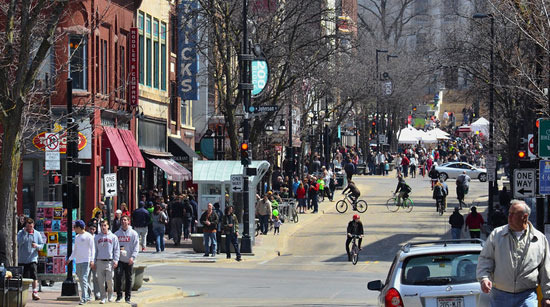
Living in Madison may seem like being in a city marked in the middle of the Midwest, but once you experience it, you feel much more connected to a wider world than expected. This city serves not just as a college town but as a central hub of the Midwest transportation network.
In particular, the radius of life based on driving is very efficiently organized, making nearby major cities feel like part of the same living area. The closest major city is Milwaukee. It takes about 1 hour and 15 minutes to drive east from Madison to reach downtown Milwaukee. Even if it's not for commuting, it's a perfect distance for weekend concerts, visiting large shopping malls, enjoying Lake Michigan, and having dinner before heading back.
There is a reason why people in Madison think of Milwaukee as "our big brother." Milwaukee is much larger and has a diverse industry compared to Madison, but the distance feels completely manageable.
And the most important connection from Madison is undoubtedly Chicago. It takes about 2 hours and 30 minutes to 3 hours to reach downtown Chicago heading southeast. Chicago O'Hare Airport is the most frequently used airport for Madison residents traveling abroad, and most events, sports games, exhibitions, and medical appointments are handled in Chicago. Saying that living in Madison means having Chicago as part of your living area is not an exaggeration.
Thus, Madison is neither a rural area nor a big city; it has the character of a mid-sized hub city backed by a major city. To the north is Wisconsin Dells. This place, reachable in just over an hour, is a famous tourist destination known for its water parks and resorts, where families from Madison almost move in every summer. Further north are small central towns like Stevens Point and Wausau, where forests and lakes begin in earnest.
To the west is La Crosse, a city connected to the Mississippi River, where the scenery changes completely. In about 2 and a half hours from Madison, you can enjoy the unique atmosphere of a riverside city. Heading south, you reach Rockford in Illinois, and a bit further, you naturally overlap with the outskirts of Chicago. At the center of all this movement is a network of highways. Roads like I-90, I-94, US-12, and US-18 stretch out from Madison, making it quick to get anywhere once you're on the road.
Therefore, people in Madison have a very everyday sense of traveling by car. Just like transferring subway lines in Seoul, in Madison, residents cross state lines every weekend. Thanks to this geographical structure, Madison offers a wide range of life choices. You can live in a quiet college town while still enjoying the culture of a big city, international airports, major hospitals, major sports leagues, concerts, exhibitions, and shopping whenever needed. At the same time, just a 30-minute drive opens up a completely different world of farms, lakes, forests, campgrounds, and ski resorts.
This balance is Madison's greatest charm. It is perfectly situated where the city and nature, the local and the global, overlap appropriately. So, after living here for a while, you rarely hear someone say, "It's inconvenient to live here." Instead, it feels more natural to say, "You can do just about anything here."







 ultron78 |
 garlic bread |
 Sugar Cream Door Bulletproof Noodles |
 urbanmint |
 |
| 
 middlekick |
 Forest Gump |


 My Love Bambino Alaview |
  forevergee |
  festival |
  manchester |
  constant |
  Leapfrog Move |
  vibranto |
  Tora Tora |
  yellowbutter |
  Dolly |
  US Embassy |
  NYC saladbar |
  Finding Superfoods |
  lightyear |
  song bang |
  vexomo |
  Indiana Jones |
  meloncat |
  novapixel |
  mortrix |
  Esther 1983 |