

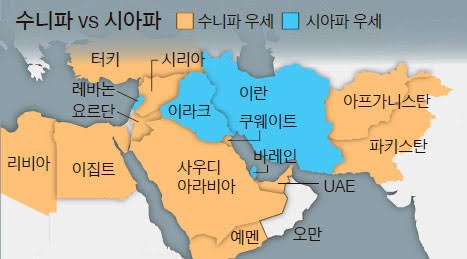
When discussing Islam, there are certain terms that always come up. One of them is the distinction between Shia and Sunni. These two terms frequently appear in news reports about conflicts in the Middle East. However, it seems that not many people truly understand why this split occurred. I used to think it was simply due to differing religions. But after doing some research, I found that the story goes back to a very long history.
The roots of this conflict trace back to the 7th century. After Muhammad, the founder of Islam, passed away in 632, a significant issue arose: who would be the next leader? At that time, the Islamic society did not have a clear separation between religion and politics. Therefore, the question of leadership was not just a religious matter but one that determined the power structure of the entire society.
Initially, many believed that the community should come together to elect a leader. As a result, Abu Bakr, a close companion of Muhammad, was elected as the first caliph. This line of thought eventually led to what we now know as Sunni Islam. Sunnis place great importance on community traditions and consensus. It is estimated that about 85 to 90 percent of Muslims worldwide are Sunni.
However, there were others who held a different view. They believed that the leader should come from Muhammad's lineage. Thus, Ali, Muhammad's cousin and son-in-law, claimed to be the rightful successor. This belief system is known as Shia Islam. The term Shia itself originally means the party of Ali.
Initially, it was merely a political disagreement. However, over time, the differences grew to encompass religious aspects as well. A particularly significant event was the Battle of Karbala in 680, which became a pivotal moment. Ali's son, Husayn, fought against the ruling power and was killed. This event holds immense significance for Shia Muslims, who remember Husayn as a martyr. To this day, rituals commemorating this event continue.
This division has persisted to the present day. Today, Sunnis are predominantly found in countries like Saudi Arabia, Turkey, Egypt, and Indonesia, while Shias are mainly located in Iran, parts of Iraq, Azerbaijan, and Bahrain. Iran is particularly known as a Shia-majority country.
As a result, many people often ask which group is responsible for more terrorism. However, this is a question that requires careful consideration. The sect itself does not create terrorism.
That said, it is true that in recent decades, many terrorist organizations featured in international news have been Sunni extremist groups, such as Al-Qaeda and the Islamic State. However, these groups do not represent all Sunnis and are often viewed as extreme minorities within Sunni Islam.
There are also armed groups within Shia Islam, such as Hezbollah in Lebanon. These groups are often described as emerging from regional politics and war situations rather than purely religious issues.
Ultimately, the important point is that the global Muslim population is nearly 2 billion. The individuals involved in terrorist organizations represent only a tiny fraction of that number. The majority of Muslims are ordinary people who work and care for their families.
Thus, many explanations suggest that factors like political situations, wars, foreign interventions, and regional conflicts are more significant than the Sunni-Shia divide. While religious differences can be a factor in conflicts, the actual causes of violence and terrorism are much more complex.
In summary, the difference between Shia and Sunni Islam originated from a historical split over who should be the leader. This intertwining of politics and religion has continued to this day, influencing Middle Eastern politics.
When you think about it, it's quite an interesting story. This conflict has lasted over 1400 years and continues to appear in international news.
Therefore, understanding the Shia and Sunni narrative can be helpful for grasping Middle Eastern news.







 El Dorado |
 postcard |
 Breaking Bad Drama |
 Coastal city |
 novapixel |
 limestone |
 PETRO Vatican Shrine |
 Bacon King Blog |
 Bald Eagle Brothers |
 treasure |
  Key spots |
  berrypup |
  Yo Lock Me Up |
  Oh my Julia |
  bibigoo |
  silents |
  Team Korea Psychoanalysis Research |
  North Dakota Ragdoll Cat Owner |
  Cap Com |
  Trot King News |
  Blondee |
  some fame |
  rapidfire |
  walnutbo |
  Shinbaram Dr. Blog |
  breaddough |
  Michigan Enthusiast |
  Only Dentalbay |