
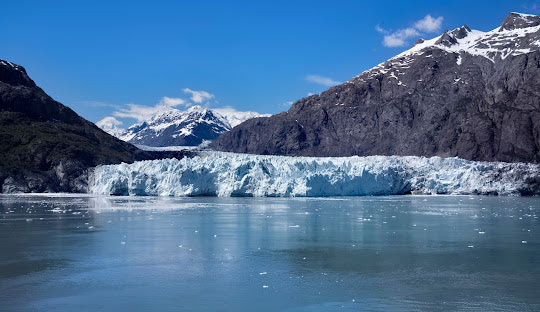
Alaska is a region rich in glaciers, covering about 5% of its total area.
Alaska's glaciers are typically found in mountainous areas or along coastlines, some of which are included in national parks and protected areas.
Alaska's glaciers represent the powerful forces of nature, and their changes and movements significantly impact local ecosystems and climate change.
Alaska has about 100,000 glaciers, some of which are massive glaciers formed over millions of years.
Approximately 600 of them boast an area of hundreds of square miles.
Types of Glaciers
- Mountain Glaciers:
Most of Alaska's glaciers are located in mountainous regions, starting at high altitudes.- Fjord Glaciers: In Alaska's coastal areas, glaciers flow into the sea, forming fjord regions (coastlines created by glaciers).
- Ice Sheets:
Extensive continental glaciers exist in northern Alaska and parts of Canada.- Large glaciers like the Columbia Glacier are examples of continental glaciers.
Major Glaciers in Alaska
Wrangell Glacier:
A glacier located at the foot of Mount Wrangell, boasting large and beautiful scenery.Portage Glacier:
Connected to Portage Lake, it can be viewed up close through boat tours.Kelp Glacier:
One of the largest glaciers in Alaska, impressive in its size and scale.
Alaska's Glaciers and Climate Change
Alaska's glaciers are among the first regions globally to be affected by climate change. In recent years, the retreat of Alaska's glaciers has accelerated, considered a significant indicator of climate change.
Glacier Retreat
- Retreat Phenomenon:
Alaska's glaciers are gradually retreating due to climate change, acting as a major cause of rising sea levels. - Annual Retreat Rate:
Many glaciers in Alaska are retreating by several meters each year, a key sign of global warming. - Impact of Glacier Retreat:
Glacial lakes formed by retreating glaciers can lead to natural disasters like flooding, which can also affect drinking water supplies.
Glaciers and Ecosystems
The retreat of glaciers also impacts local ecosystems. Glacial sediments formed in glacial lakes provide an environment for new life to thrive.
Glacier Tourism in Alaska
Alaska's glaciers offer great appeal to tourists with their beauty and grandeur. There are various activities and tourist attractions related to glaciers.
Glacier Tours
Portage Glacier:
Portage Glacier can be accessed via boat tours, allowing visitors to enjoy the scenery of the glacier and lake up close.Kenai Fjords National Park:
This park offers glacier cruise tours, where visitors can admire glaciers flowing into the sea and the fjords.Helicopter Tours:
In Alaska, helicopter tours allow for aerial observation of glaciers. Some tours offer glacier landings, enabling visitors to walk on the glacier.Denali National Park:
Helicopter tours are available that not only showcase glaciers but also provide views of Mount Denali, allowing visitors to enjoy various glaciers and nature within the park.
Glaciers and Scientific Research
Alaska's glaciers play a crucial role in climate change research. Researchers measure the thickness and retreat rates of glaciers to collect data on climate change and environmental changes.
Importance of Glaciers:
Glaciers serve as important records of Earth's climate change, allowing scientists to study glaciers to track Earth's history and climate changes.Glacier Research Centers:
Alaska has various glacier research centers and climate change research facilities studying glacier changes and their environmental impacts.



 AL ALASKA |
 Information on Area Codes in the Americas |

 Alaska Kim |

 Omelet Rice for Strength |
  US Embassy |
  Korean Mom |
  My NYC |
  moo moo |
  Mr Oh |
  forevergee |
  festival |
  manchester |
  constant |
  Leapfrog Move |
  vibranto |
  Tora Tora |
  yellowbutter |
  Dolly |
  NYC saladbar |
  Finding Superfoods |
  lightyear |
  song bang |
  vexomo |
  Indiana Jones |