


Austin is commonly known as a high-tech industrial city where global companies like Tesla and Apple are concentrated.
However, if you had to name the biggest influence that shaped the city into what it is today, it would be the University of Texas at Austin, or UT Austin.
It is not an exaggeration to say that the university grew first, attracting companies, research institutions, and startups around it, which led to the Austin we know today.
In fact, UT Austin is one of the top public universities in the United States.
According to U.S. News & World Report 2026, it ranks first among Texas public universities, seventh among public universities in the U.S., and is within the top 30 in the overall ranking that includes both public and private institutions. Its business programs in accounting, finance, and marketing are rated among the best in the country, and its programs in petroleum engineering, chemical engineering, and civil engineering are also recognized as top-tier nationally. Its research competitiveness is very high, as evidenced by the Manhattan Institute's 2025 college rankings, where it placed second in the nation.
Above all, the greatest advantage of UT Austin lies outside the campus. Located just north of downtown Austin, it is natural for students to walk to restaurants and cafes, attend performances, and participate in corporate events or startup networking after classes.
With over 50,000 enrolled students, it is a massive university. Therefore, the campus itself resembles a small city.
It boasts extensive libraries, research facilities, and sports facilities, as well as hundreds of student organizations and career fairs. Notably, global companies like Apple, Dell, AMD, NVIDIA, Tesla, and Samsung's Austin campus are nearby, providing ample internship opportunities. This is why it consistently appears in Forbes' 2025 America's Top Colleges list.
The tuition for the 2025-2026 academic year for Texas residents (In-State) is approximately $12,000 to $14,000 per year for undergraduate tuition and mandatory fees.
In contrast, out-of-state and international students can expect tuition to rise significantly, averaging around $45,000 to $48,000 per year.
When including costs for housing, food, and textbooks, total educational expenses can reach about $30,000 per year for Texas residents, while out-of-state and international students may exceed $60,000. Of course, many students reduce their financial burden through scholarships and research assistant programs.
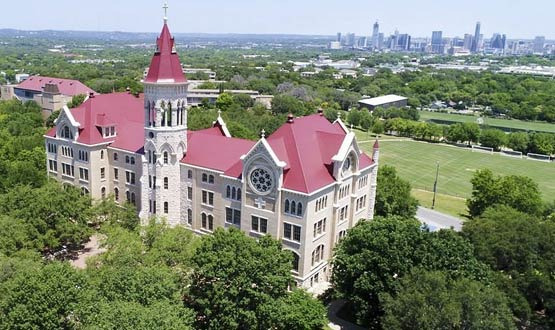
Austin is not just home to UT. To the south of the city is St. Edward's University.
While much smaller than UT, it is well-regarded for its close-knit liberal arts education. According to Forbes 2025, it ranks 293rd nationally, and its smaller class sizes make it popular among students who prefer discussion-based learning.
Tuition is relatively high for a private university, at around $53,000 per year, and when including housing and living expenses, total costs can exceed $70,000. However, it offers various scholarship programs, so the actual financial burden can vary significantly among students.
Further north, you will find Southwestern University located in Georgetown. Known as one of the oldest universities in Texas, it has a small student body of about 1,500. In Forbes 2025, it ranked 304th nationally.
This school also provides a liberal arts-centered education and emphasizes close relationships between professors and students. Tuition is around $50,000 per year, similar to the private university average, but it is also known for its high scholarship award rates.
Additionally, Austin Community College (ACC) is an important educational institution for local residents. Although it is a two-year community college, it offers very affordable tuition for Texas residents, at just a few dozen dollars per credit hour, and many students complete their foundational courses there before transferring to UT Austin or other universities. It is considered a practical option for students looking to reduce costs.
Ultimately, choosing a university in Austin is not just about picking a school name. It is also a process of deciding where to spend your youth.
If you want to grow alongside global companies at a world-class research university, UT Austin would be appealing. If you prefer a more family-like atmosphere with intensive education, St. Edward's or Southwestern University could be good choices. If cost-effectiveness is a priority, transferring through Austin Community College is also a viable option.
Austin has grown because of its universities, and now the city is creating more opportunities for students in a positive cycle. Therefore, college life here is likely to be more than just four years of earning a diploma; it is a chance to experience the energy of one of the fastest-growing cities in America.
 Fluffy Puppy
 MaxPromo
 HoneyDreamer



 Magic Cabbage School of Martial Arts |
 Vacation on Hawaii |
 morvex37 |
 Ari Songhan American Immigration Life |
 Bearded Strawberry Smoothie |
 |
| 
 Living with a Consistent Heart |
 U.S. Weather Bureau News |
 Dallas Fort Worth DFW |
 novent |
  Rhode Island Good People |
  Big North |
  Famous Attractions in the United States |
  Jin Soo V |
  Starbucks Reserve Roastery Closure |
  peppermint |
  Stable Co. |
  Purple Moons, |
  International Court |
  roma |
  horse |
  moodansa 77 |
  zymit |
  maplefox |
  Fun Flex Life |
  hopeful |
  Reeno |
  Coastal city |
  meonetoo |
  Winter bear |