

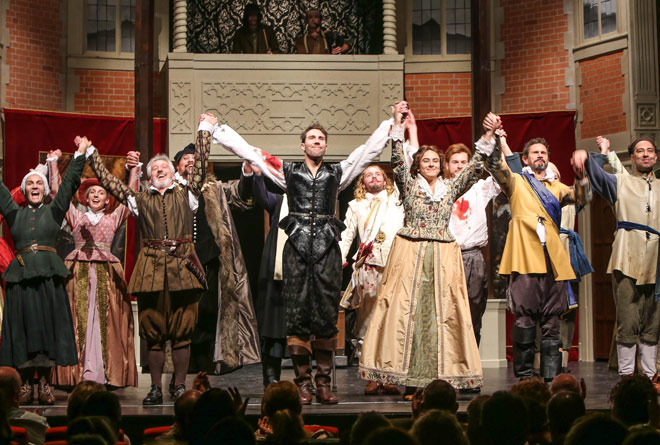
When watching American movies or dramas, there are times when a completely different tone of English appears compared to what we usually hear.
This feeling is particularly strong in the historical drama genre featuring medieval or royal settings. It's not just due to the historical background. In fact, several characteristic elements combine to create what we commonly refer to as the "historical drama English tone." Broadly speaking, it can be seen as a style that combines elements like vocabulary, intonation, sentence structure, and acting style.
The first noticeable aspect is the use of old words and archaic terms. Expressions that are rarely used in modern English appear. A representative example is the second-person pronoun. Nowadays, "you" is used in almost every situation, but in old English, there were several forms. When used as a subject, it was "thou," as an object, it was "thee," and the possessive form was "thy." When such words appear, the atmosphere suddenly changes. And for those who are not familiar with English, they might pause and think, "What does this mean?"
The verb forms are also different. In old English, verbs sometimes have endings like -eth or -est attached. For example, instead of "he speaks," you might hear "he speaketh," and instead of "you know," it could be "thou knowest." These expressions are rarely used in everyday conversation but often appear in movies or dramas. So, even if one thinks they know English to some extent, they might momentarily stop interpreting when such expressions come up.
Another characteristic is the intentional mixing of old words. For instance, instead of "why," you might hear "wherefore," instead of "from there," it could be "thence," and instead of "perhaps," it might be "perchance." These words are rarely seen in modern English but are quite effective in creating a historical drama atmosphere. However, for viewers, this can complicate their understanding once again.
Pronunciation and intonation are also important elements. In historical dramas, a special tone is often used to give the audience a classical and dignified feeling. Especially, royal or noble characters often use pronunciations closer to British accents. The reason for using British pronunciation in American films is simple: it gives Americans a sense of something older and more authoritative.
Additionally, the Mid-Atlantic Accent frequently appears. This accent is a blend of American and British pronunciations. It was often used in classic Hollywood films or plays to portray intellectual or noble characters. While it is rarely used in everyday life now, it is still utilized in films to create an old-fashioned atmosphere.
The sentence structure is also somewhat different. In historical English, inverted sentences often appear. While modern English would say, "I do not know," in a historical tone, it might be expressed as "I know not." This method of intentionally changing the order of sentences creates a grand feeling. Some people refer to such expressions as a solemn style, though I'm not sure about the exact linguistic term. However, the moment you hear it, you immediately think, "Ah, that's the tone of a historical drama."
Moreover, expressions in historical dramas tend to be longer and more figurative. In modern English, what could be said briefly is often elaborated with metaphors or modifiers, making it longer. This adds authority and weight to the speech. There are many scenes where kings, knights, or noble characters speak in this manner.
In fact, a similar phenomenon can be observed in Korea. Korean dramas also have a distinct historical drama tone. Expressions like "Your Majesty," "I humbly report," and "My lord" are examples. These are phrases that are never used in everyday conversation but sound natural in historical dramas. Therefore, when Koreans hear the tone of English historical dramas, they often unconsciously accept it with a similar feeling. It feels like a foreign version of a historical drama tone.
There is another reason. For Koreans, English is still a foreign language. So, even a slight difference in tone or intonation feels much more special. While it may just be a cinematic portrayal for Americans, it leaves a stronger impression on Koreans.
In fact, when you ask Americans, their reactions are somewhat different. They usually think that such tones sound like "Shakespearean style" or "old English feel." They may find it cool, but they often do not perceive it as uniquely special as Koreans do.
Ultimately, the reason Koreans are drawn to the tone of English historical dramas is due to the combination of various elements. Strange words, unique intonations, grand sentence structures, cinematic portrayals, and similarities to Korean historical drama culture all play a role.
So sometimes, when you see such scenes, it can make you smile. Even if you usually find it difficult to understand English, when someone in a movie says, "My lord..." it suddenly sounds impressive.
Perhaps language is not just a tool for conveying meaning but also a means of conveying atmosphere and emotion. This may be why the tone of English historical dramas feels particularly striking.







 Balancework |
 Make My Day |
 viroma |
 eatontown blog |
 Toaster Pizza Magic Show |
 Margarine Daebimama |
 squidogame |
 cloudyday |
 Tiger Milk Foam Research Institute |
  Oreore Mushroom |
  optimistic |
  Good Good |
  berion88 |
  bravo777 |
  skyblue |
  Project Tomorrow |
  apricotla |
  Soy Angelino |
  nati8 |
  NE Hodori Preik |
  washington mom |
  celtics |
  round1 |
  Way to easy |
  musicque |
  road98 |
  Churros Train Conductor |