
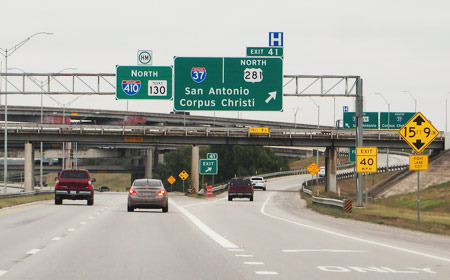
The freeway system in Texas, especially the freeways in San Antonio, has unique aspects compared to other states.
Below, I will introduce some interesting and unique features of Texas freeways one by one:
The roads are very wide and straight
Texas is a state known for its plains and vast land, and accordingly, its highways are often very wide and straight. In particular, roads like I-10 and I-20 have stretches that run almost straight for hundreds of miles. While these roads are easy to drive on, they can sometimes feel long and boring. There are not many passenger cars moving between cities, and it is common to see large trucks, like those transporting goods, driving at the speed limit of 80 miles or more.
Frontage Roads
The concept of Frontage Roads is very common in Texas's freeway system (see the photo below). These roads, located on both sides of the freeway, run parallel to the freeway and are used for vehicles to enter or exit the freeway.
This system plays an important role in connecting freeways to local roads and is very useful for traveling between urban and suburban areas. Many Texas freeways are designed to allow quick access via these frontage roads, which provide numerous advantages. When exiting the freeway to local roads, the use of frontage roads significantly reduces the bottlenecks that can easily occur when exiting via freeway ramps.
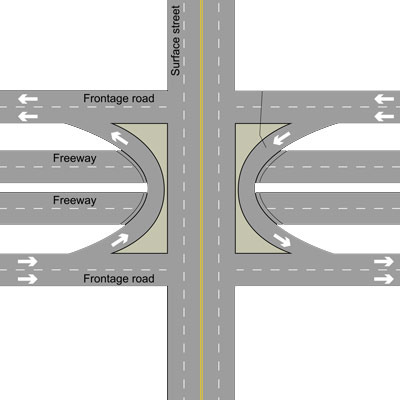
'Texas U-turn' or 'Texas turnaround'
In Texas, the method of making a U-turn on the freeway is facilitated by designated Texas turnaround areas (see the photo above). A "Texas U-turn" refers to a turning area designed to allow drivers to turn in the opposite direction on the freeway. These U-turn areas are sometimes accessed via dedicated exits from the freeway, making it very efficient to change direction. When the navigation says 'Sharp left turn', it means to enter the opposite lane of the freeway via the Texas turnaround road instead of making a left turn.
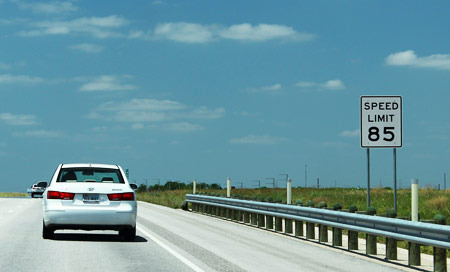
"85mph Speed Limit" Zone
The 85mph speed limit in Texas is found on State Highway 130 (SH 130), a toll road connecting Austin and San Antonio. This freeway section is the fastest freeway in the United States. Of course, drivers must operate safely, and the speed limit changes to 70 miles per hour after passing through this area.
Large-scale Road Construction and Expansion Projects
Texas is a rapidly growing state, so freeway expansion projects are constantly underway. For example, major roads like I-35 and I-10 are continually adding lanes, and in some areas, multi-layered bridge interchanges or elevated roads are emerging. Especially in metropolitan areas like Dallas-Fort Worth, such freeway expansion projects are actively ongoing.
In this way, Texas freeways have different characteristics compared to other states, boasting an efficient transportation network due to their unique design that reflects Texas's vast terrain and traffic demands.






 Helpful Life Stories |
 American Man in a Mask |
 USA Pharmacy Pharmacist |
 Texas Migration Story |
 Texas Migration Story |
  Tonky |
  viroma |
  cookie |
  Live and that's it |
  Alright Twain |
  eatontown blog |
  HAWAII Korean Church News |
  Amore |
  linex |
  Balancework |
  laro90 |
  MEDBIO American Doctor Blog |
  SWAT TEAM BLK |
  DREAM BIG |
  frostbite |
  330 Forever My Love |
  El Dorado |
  dralix58 |
  Gorama Round |
  Skydiving |