
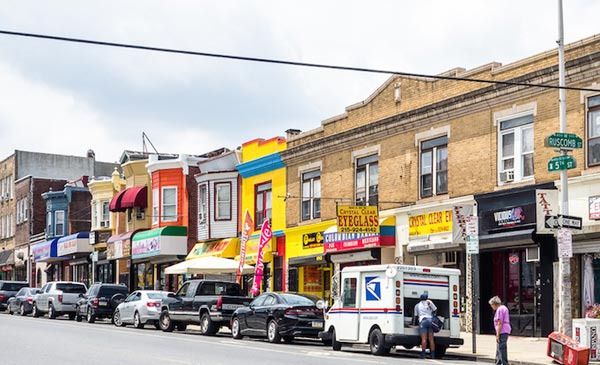
When discussing the Korean immigrant community in Philadelphia, one cannot overlook the Olney area. This place is known for being an old residential area located in the northern part of the city, with a large Black population and a dense concentration of Korean businesses.
The shops lined along North 5th Street are a representative street that showcases the roots of the Korean community. Even today, if you walk down that street, you will find laundries, markets, delis, and beauty supply stores with Korean signs, while residents go about their daily lives in between.
Since the 1980s, most Korean immigrants who came to the United States were not proficient in English and lacked sufficient capital. At that time, the competition in downtown Philadelphia was fierce, and the relatively low rent in the Olney area emerged as a new settlement destination. Here, Koreans began their livelihoods by operating businesses closely tied to daily life, such as laundries, convenience stores, delis, and grocery stores.
The majority of customers were Black residents, and the business district naturally developed in a way that connected these two communities. A 2005 study by the University of Pennsylvania analyzed that the roles and social relationships of Korean merchants in this area were a significant part of the urban economy, making Olney's Korean business district a pillar of Philadelphia's economy.
At that time, North 5th Street was filled with advertisements and newspapers in Korean, and stores displaying products imported from Korea lined the street. Koreans opened their shops early in the morning and worked late into the night, memorizing customers' names and continuing transactions on credit. Despite cultural differences and language barriers, trust naturally built up within the necessary relationships. For Korean merchants, Black customers were the foundation of their livelihoods, and for Black residents, Korean stores were an important space to purchase daily necessities.
Of course, the relationship was not always smooth. Economic competition, racial misunderstandings, and social distrust sometimes led to conflicts. Some Koreans felt fear after experiencing shoplifting or violent incidents, while some Black residents thought that Koreans did not understand them. However, many merchants persevered through these situations with 'trust.' They greeted customers while making eye contact, occasionally allowed credit transactions, and donated to local church or school events, gradually lowering the walls of their hearts. Through these relationships, mutual understanding grew, and some Koreans even participated in local community associations to solve problems together.
As time passed, Olney has changed significantly. With generational shifts, some Korean stores have closed or moved to the suburbs, but a few still remain at the center of the community. Some laundries, beauty supply stores, and delis on North 5th Street have maintained their positions for over 30 years, continuing to be part of residents' daily lives. Although the number of Korean signs has decreased, the remaining stores stand as symbols of the sweat, effort, and perseverance of the first generation of immigrants.
Today, Olney is not just a 'Korean business district,' but a space that contains traces of coexistence between immigrants and local residents. Korean merchants have become part of the community beyond mere survival, and their stores have evolved into spaces for cultural understanding as well as economic exchange. It has become commonplace for Black customers to become regulars and for Korean merchants to inquire about the well-being of local elders.
Korean stores are still actively operating in other areas of Philadelphia, such as Cheltenham or some Black neighborhoods in the north. However, the significance of Olney is somewhat different. This place is the stage of history where Korean immigrants have rooted themselves and lived alongside the Black community in Philadelphia.



 Northeastern |
 Nationally Certified Lightning Charcoal Review |
 sparkling |
 American Grape Shine Muscat |
 U.S. Weather Bureau News |
  laro90 |
  MEDBIO American Doctor Blog |
  SWAT TEAM BLK |
  DREAM BIG |
  frostbite |
  330 Forever My Love |
  El Dorado |
  dralix58 |
  Gorama Round |
  Skydiving |
  dreamport |
  Yellow Snowman |
  Toaster Pizza Magic Show |
  velvetnom |
  Anytime Journey |
  Mrs. Duluth |
  jaxter |
  Atlanta Mama |
  Baguette Blog |
  Tan Sol |