

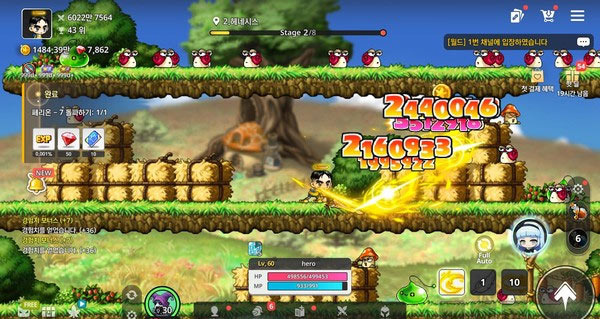
Once, out of boredom, I played the MapleStory background music on YouTube. After about 10 seconds of the Elinia BGM, old memories came flooding back.
Henesys, Ludibrium, hunting slimes, and the chat window where I used to chat with friends.
MapleStory appears to be a cute side-scrolling game on the surface, but in reality, it's a routine game that endlessly consumes players' time.
It pretends to be a simple RPG from the days of hunting slimes, but looking at its current structure, you have to manage equipment setups, enhancement probabilities, boss cuts, and event efficiency calculations. It's often said that instead of playing a game, it feels like managing an Excel file.
On top of that, there's a mix of nostalgia and sunk cost fallacy. The thought of "I've come this far, it feels like a loss to quit now" keeps players hooked.
Both characters and monsters look cartoonish. However, when you look at the actual structure, it's not a children's game at all. It's designed to dominate the user's daily routine as a long-term service game.
Those who remember the old MapleStory recall it as a game where they hunted slimes and chatted in Henesys.
But looking at the current MapleStory, it's a completely different structure. You have to calculate growth paths, set up equipment, time boss entry cuts, calculate event efficiency, and manage core enhancement timings. When you start considering burning timings, enhancement probabilities, and item efficiencies, your mind almost turns into a spreadsheet.
On the surface, it still looks like a cute game, but the actions players take are almost like Excel management. The UI may be cute, but the system is quite hardcore. It's a clever design that gradually increases complexity to instill this sense in users: "I've come this far." From that moment, it becomes hard to quit the game.
Nexon's decision to reintroduce the classic world for its global 20th anniversary shows that this is not just a sentimental service. It's a precise business judgment. New content has become too complicated, and old users may return due to nostalgia. Thus, they employ a two-track strategy: one to retain existing users with the latest content and another to attract returning users with classic nostalgia. From a product management perspective, it's a pretty clean structure.
Extending the winter event until mid-March follows the same logic. It creates a daily routine during the event period and solidifies login habits. This is a retention strategy often used in mobile games, but MapleStory has been doing it in PC MMORPGs for 20 years. So once you get into a routine, you tend to stay longer than expected.
The reasons why the MapleStory fandom still exists can be divided into three parts. The first is nostalgia. Just a few seconds of the Ludibrium BGM brings back memories of that time. Other games may have characters you level up, but MapleStory is a game that saves time. So just hearing one piece of music can trigger memories.
The second is habit. MapleStory has a rhythm that your hands remember. Patterns for hunting monsters, skill cycles, and repetitive routines stick with you. This is why, even after a long break, you find yourself returning during event seasons.
The third reason is a bit funny: pride. You think, "I've leveled up to this spec." "I've invested this much here." This feeling is closer to sunk cost fallacy than affection. This is why players sometimes complain about the game but can't completely leave it.
This structure is hard to understand from the outside. People complain all the time, yet they return during event seasons. That's MapleStory.
It's hard to say that MapleStory has lasted 20 years simply because it's fun. The structure that ties together user habit circuits, sunk cost psychology, and nostalgia has kept this game alive for a long time. From a game design perspective, it's quite an impressive design. At the same time, for the users within it, it can feel a bit scary.
On the surface, it still looks like a cute side-scrolling RPG. But hidden within it is a service structure that keeps people engaged for a long time. I believe the reason MapleStory is still alive is ultimately due to that design.
When discussing ways to quit MapleStory, there are realistic methods.
Because MapleStory's structure encourages continuous logins due to habits and routines, breaking that routine is key. Therefore, the most effective method is not to say, "I'll just not log in today," but to completely block access for a certain period. For example, not logging in for two weeks or a month. After this period, the habit of automatically wanting to start the game significantly decreases.







 Agenda Center |
 HAWAII Korean Church News |
 Gorama Round |
 LIZ Legal Information Blog |
 Egg Steamed Pot |
  newyorker 101 |
 PPAP Pineapple Pen |
 NYC saladbar |
 Encyclopedia of New York and Surrounding Areas |
 Eating Gukbap and Working Hard Deer |
  urban legend |
  coolriver |
  Good Neighborhood, Wealthy District Information |
  Ro Ro Car |
  Amber H |
  new sugar |
  Palm 1000 |
  loran |
  donutfield |
  Tennis City |
  sunny7 |
  Questions about firearms while living in America |
  Shoot Me |
  mochifox |
  zucchini |
  Anna Life |
  Exciting FM Radio |
  pet dog |
  toodin |
  rosed |