
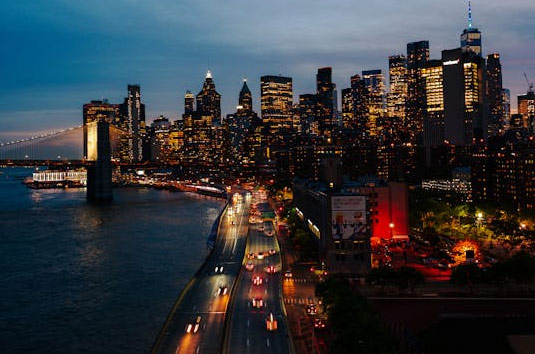
The history of New York City is a colorful story that has played a significant role in American and world history.
Since its founding, New York City has undergone constant change, establishing itself as one of the most influential cities in the world.
The history of New York begins with the European colonial era, encompassing the American Revolutionary War, waves of immigration, and the transformation into a modern multicultural society.
Indigenous Peoples and European Discovery
The area where New York City is located was originally inhabited by the Lenape, an Algonquin tribe. They called this area "Mannahatta," which means "many hills."
In 1609, the Dutch explorer Henry Hudson became the first European to explore this area, sailing along the Hudson River and surveying the region's resources. This led the Netherlands to intend to colonize the area.
Dutch Colony: New Amsterdam
In 1624, the Dutch East India Company established a Dutch colony on present-day Manhattan Island, named New Amsterdam. New Amsterdam thrived as a center of trade, with the entire island famous for its natural harbor, becoming a hub for commerce.
In 1637, nearby islands, including Governor's Island, became part of the Dutch colony, and New Amsterdam grew into a major commercial city for the Netherlands. During this time, New Amsterdam was home to a diverse mix of races and ethnicities, particularly blending cultures through interactions with the Dutch, Africans, and Indigenous peoples.
British Colony: New York
In 1664, the British conquered the Dutch colony and renamed New Amsterdam to New York. King Charles II of England granted the area to his brother James, who named it New York. New York soon became an important trade port for the British, establishing itself as a center for commerce across the Atlantic.
During this period, New York was a city where various ethnicities and cultures coexisted, with people from England, the Netherlands, and Africa living together. The institution of slavery and waves of immigration significantly impacted New York during this time.
The American Revolutionary War and New York City
In 1776, the American Revolutionary War broke out, and New York City became an important battleground. On July 4, 1776, the Declaration of Independence was announced, and New York was one of the centers supporting this declaration among the 13 colonies. In September 1776, British forces occupied New York, and at one point during the war, New York was used as a military base by the British, causing many American citizens to flee or suffer in the city.
Industrial Revolution and Urbanization
In the early 19th century, New York underwent rapid industrialization and urbanization alongside the Industrial Revolution. During this time, New York grew as a center of commerce, trade, and finance, attracting waves of immigrants.
- Immigration: Particularly, immigrants from Europe viewed New York as a land of new opportunities, significantly influencing the city's economic and social changes. Immigrants drove the city's economic growth, with many contributing as lower-class laborers in industrialization and urban construction.
- Elevators and Skyscrapers: In the late 19th century, the invention of elevators and the emergence of skyscrapers transformed New York into a city of tall buildings. This shaped the Manhattan skyline and established New York City as an icon.
20th Century: Center of Finance, Great Depression, and World War II
In the 1920s, New York established itself as the financial capital of the world. Wall Street became an internationally significant financial hub, and the New York Stock Exchange played a crucial role in the global economy.
However, the Great Depression in 1929 had a significant impact on New York's economy, leading to widespread unemployment and economic instability. Nevertheless, New York City later underwent industrialization and economic recovery during World War II.
Modern New York: A Multicultural Society and Global City
From the late 20th century to the 21st century, New York has established itself as a global center of culture, economy, and art. The five boroughs of New York, divided into Manhattan, Brooklyn, Queens, the Bronx, and Staten Island, have transformed into a multicultural society where diverse cultures, languages, and races coexist.
Icons of New York
- The Empire State Building, the Statue of Liberty, and the Brooklyn Bridge are iconic symbols of New York, world-renowned and captivating millions of tourists visiting the city.
The history of New York City holds significant meaning in the fusion of diverse cultures and ethnicities, economic challenges, and the process of urbanization. As a symbol of iconic architecture and an economic center, New York continues to function as an important cultural and economic hub worldwide, playing a vital role in both American and world history.








 newyorker 101 |
 Things to Do to Buy a House |
 U.S. Weather Bureau News |
 International Court |
 NYC saladbar |
  Tonky |
  viroma |
  cookie |
  Live and that's it |
  Alright Twain |
  eatontown blog |
  HAWAII Korean Church News |
  Amore |
  linex |
  Balancework |
  laro90 |
  MEDBIO American Doctor Blog |
  SWAT TEAM BLK |
  DREAM BIG |
  frostbite |
  330 Forever My Love |
  El Dorado |
  dralix58 |
  Gorama Round |
  Skydiving |