
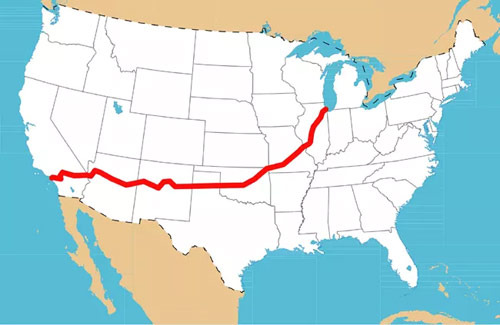
Route 66 is a road that holds symbolic meaning in American history and culture, also known as the "Main Street of America" or "Mother Road." This road has become a symbol of westward expansion, the Great Depression, and the culture of automobile travel, and is considered a path filled with memories and dreams for Americans.
Opened: November 11, 1926
Length: Approximately 2,448 miles (3,940 km)
Starting Point: Chicago, IL
Ending Point: Santa Monica, CA
States Passed Through: Illinois, Missouri, Kansas, Oklahoma, Texas, New Mexico, Arizona, California
Background of Construction
Route 66 was one of the major roads built to connect the eastern and western United States, designed as part of the American highway system in the early 1920s. At that time, there was a need to expand the road network connecting agricultural areas and major cities, and Route 66 represented this road.
The Great Depression and Westward Migration
During the Great Depression and the Dust Bowl in the 1930s, Midwestern farmers migrated to California in search of a better life, and Route 66 served as a major thoroughfare. John Steinbeck's novel *The Grapes of Wrath* vividly depicts the westward migration against the backdrop of this road.
The Golden Age of Automobile Travel
In the 1940s and 50s, as American automobile travel culture flourished, Route 66 emerged as an important tourist road. Iconic establishments such as motels, diners, gas stations, and neon signs sprang up along the roadside, making it a representative path of American road trip culture.
Decommissioning and Preservation Efforts
In 1985, Route 66 was officially decommissioned with the completion of the Interstate Highway System. However, efforts to preserve the historical value of the road continued, and it has now become a tourist attraction known as "Historic Route 66."
Route 66 reflects the geography and culture of America, offering a variety of landscapes and attractions.
- Chicago: Famous as the starting point, where you can explore the city and historical landmarks.
- Gateway Arch, St. Louis, Missouri: A landmark of the Midwest, commemorating the westward expansion of the United States.
- Kansas Section: The shortest stretch at about 13 miles, but in excellent preservation.
- Williams, AZ: A picturesque small town, serving as a gateway to the Grand Canyon.
- Santa Monica: The endpoint in California, where you can see the "Route 66 End of the Trail" sign at the Santa Monica Pier.
Cultural Significance
Route 66 symbolizes not just a road, but the history, culture, and changes in life in America.
In literary works like *The Grapes of Wrath*, this road is depicted as a symbol of hope and despair. The song *"Get Your Kicks on Route 66"* by Nat King Cole in 1946 further elevated the road's fame. The neon signs, diners, and motels along the road have become icons of American retro culture.
Today's Route 66
Although Route 66 is not used as an official highway, many restored sections as "historic roads" allow tourists to still enjoy it. For those wanting to experience American road trips, it offers an attractive path to explore the old road and surrounding towns, providing an opportunity to feel the history of America.






 roma |
 calviro |
 Kansas City Representative Singer |
 calvix |
 Iri Jori Missouri |
  Atlanta Mama |
  Baguette Blog |
  US Embassy |
  Korean Mom |
  My NYC |
  moo moo |
  Mr Oh |
  forevergee |
  festival |
  manchester |
  constant |
  Leapfrog Move |
  vibranto |
  Tora Tora |
  yellowbutter |
  Dolly |
  NYC saladbar |
  Finding Superfoods |
  lightyear |
  song bang |