
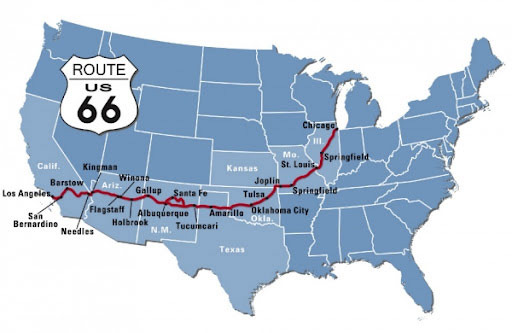
U.S. Highway 66, commonly known as Route 66, holds a complex and rich history beyond just being a road.
This road serves as an artery of transportation and a driving force for social change, while also being an iconic symbol that preserves America's past heritage.
Spanning approximately 2,400 miles (3,862 km), Route 66 crosses about two-thirds of the continental United States, connecting the east and west, and showcasing the historical process that transformed the lives and communities of Americans.
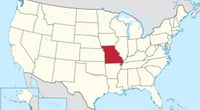
Route 66 begins at the shores of Lake Michigan, passes through the farmlands of Illinois, the gentle hills of the Missouri Ozarks, and the mining towns of Kansas. It also traverses the point where the eastern forests meet the vast plains of the west in Oklahoma, crosses the ranching areas of Texas, the mystical mesa landscapes of New Mexico and Arizona, and finally leads to Los Angeles and the Pacific coast, known as the "land flowing with milk and honey."
The historic buildings and various cultural resources lining the road connect America's past and present, showcasing the traces of change that people have experienced. This legendary road not only connects east and west but also plays a crucial role in linking the past and present.
Route 66 officially began in 1926 when the Bureau of Public Roads introduced the federal highway system. This road was created by connecting and combining existing local, state, and national roads.
Thanks to the active promotion by the U.S. 66 Highway Association, Route 66 quickly became a popular route. The association advertised this road as "the shortest, most optimal, and scenic route from Chicago through St. Louis to Los Angeles," strongly recommending it to travelers.
Route 66 is not just a road; it remains a legendary path symbolizing America's culture and historical change, connecting the past, present, and people.




 roma |
 calviro |
 Kansas City Representative Singer |
 calvix |
 Iri Jori Missouri |
  US Embassy |
  Korean Mom |
  My NYC |
  moo moo |
  Mr Oh |
  forevergee |
  festival |
  manchester |
  constant |
  Leapfrog Move |
  vibranto |
  Tora Tora |
  yellowbutter |
  Dolly |
  NYC saladbar |
  Finding Superfoods |
  lightyear |
  song bang |
  vexomo |
  Indiana Jones |