
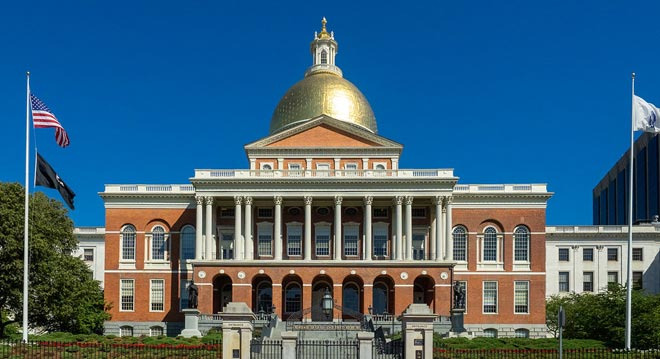
The Massachusetts State House, standing tall on Beacon Hill in the heart of Boston, is not just an administrative building. It is a symbol that embodies the spirit of American founding and the dignity of New England.
When you first see this building, the first thing that catches your eye is the golden dome. It sparkles in the sunlight, making it visible from afar. Originally, it was covered with copper plates over a wooden roof, but later it was gilded with pure gold. Thanks to this, it is now called the 'Golden Dome of Boston' and has become a symbol of the city. This dome is not just a decoration; it symbolizes "light and freedom," as if the ideals of American democracy radiate from this place. The
State House was completed in 1798, designed by Charles Bulfinch, a name that cannot be omitted in American architectural history. He was the first professional architect in America and influenced the design of the Capitol in Washington D.C. At that time, the Massachusetts State House was a representative work of his conceived 'Republican Style' architecture. The marble columns, brick exterior, and symmetrical facade are the result of interpreting European neoclassicism in an American way. The location of the State House is also symbolic.
This place was originally one of the highest hills in Boston. During the American Revolutionary War, it was where citizens gathered to listen to speeches and soldiers trained, right across from Boston Common. After independence, building the State House on this hill was meant to convey the idea that "the center of a free nation lies above the people." In fact, when you look down from the front of the building, you can see the wide expanse of Boston Common, which extends to the harbor beyond. It is as if this place serves as a 'beacon of freedom,' overlooking the entire city.
Inside, the building is grand yet dignified, as befits a public building. The stairs and corridors are made of marble, and the ceilings are high and arched. The walls are adorned with portraits of Massachusetts history and independence activists, with the portraits of Paul Revere and Samuel Adams particularly standing out. Their names are well-known due to the Battle of Lexington and the Boston Tea Party. Additionally, there is a space called the 'Rotunda' inside the Capitol, which is like the heart of Massachusetts.
Looking up at the ceiling, light pours down from beneath the dome, and the floor is engraved with a star symbolizing the state. This place becomes the central stage for the governor's inauguration and official events. Another charm of the State House is the 'harmony of the old and the new.' The original building was constructed at the end of the 18th century, but as the population and administrative scale grew, it underwent two expansions in the late 19th and 20th centuries. However, what is remarkable is that the newly constructed parts have inherited Bulfinch's original design philosophy.
Thus, even today, the entire State House appears as a harmonious work of art. Behind the building is the 'New State House,' which houses the executive offices and meeting rooms. Also, in the garden in front of the building, statues of heroes from the Revolutionary War are erected, with the statue of General George Washington always being a popular photo spot for tourists.
Especially in spring, the garden blooms with cherry blossoms and tulips, making it look like a movie set. Right in front of the State House runs the Freedom Trail, a red brick path that follows the footsteps of American independence, and the Massachusetts State House is one of the stops along this route. Therefore, tourists are never-ending throughout the year.
Some come to study history, while others simply come to see the golden dome. The State House is still an active building where the state legislature and executive branch operate. Politicians hold meetings, journalists gather for interviews, and citizens submit petitions. But at the same time, it is a 'public space' open to everyone.
There are free tours, and school groups often come for field trips. So, as you walk around the State House, you feel a sense of coexistence between the past and the present. The Massachusetts State House is not just a government building but a place where 'the legacy of freedom is alive.'







 candytip |
 Gold Bar |
 Pirate Ship Popcorn Maker |
 Montgomery Mom |
 Anjollinya Blog |
 Tart Tart |
 tiramisu |
 NO CAP LIFE |
 bagel90 |
 lattecu |
  manchester |
  constant |
  Leapfrog Move |
  vibranto |
  Tora Tora |
  yellowbutter |
  Dolly |
  US Embassy |
  NYC saladbar |
  Finding Superfoods |
  lightyear |
  song bang |
  vexomo |
  Indiana Jones |
  meloncat |
  novapixel |
  mortrix |
  Esther 1983 |
  fortbliss |
  Moscow Kim |